
Celebrating 120 years of the International Electrotechnical Commission, part 3: IDEC's contributions to standardization
Date: 07/14/2026 | By: IDEC HQ
It’s been 120 years since the International Electrotechnical Commission (IEC) was founded. Our 3-part series of articles on the IEC celebrates this milestone anniversary, and the many achievements and technological developments along the way.
Part 2: IEC standards that changed industrial safety for the better
Part 3: IDEC’s contributions to international standardization and industrial safety
IDEC’s ongoing contributions to IEC standards, and to comprehensive safety measures in industrial workplaces
Some of our knowledge about the IEC’s history, technical committees and standards comes from in-house safety training and research.
Much of it comes from our direct involvement with the IEC for close to 30 years.
IDEC’s presence on IEC and ISO technical committees began in the 1990s. We actively help to create and shape the rules that govern industrial safety, showing that Japan can take the lead in international standardization.
In 2003, IDEC representatives suggested that the IEC should publish an international standard for 3-position enabling switches. 3 years later, in October 2006, the result was:
IEC 60947-5-8 (Low-voltage switchgear and controlgear - Part 5-8: Control circuit devices and switching elements - Three-position enabling switches)
IEC 60947-5-8 was revised in 2020, to include 3-position enabling switches that are mounted on teaching pendants.
Repeated recognition for our efforts, input, and expertise in standardization
In 2004, the IEC created the 1906 Award for outstanding individual achievements. One of our in-house safety standardization experts, a member of the IEC subcommittee for low-voltage switchgear and controlgear, won the award in 2021.
As a company heavily involved in standardization, we continue to represent Japan on the IEC Advisory Committee for Safety (ACOS), and persuaded the committee to develop a guide to Collaborative Safety (Safety 2.0).
That guide, IEC Guide 127 (Guidelines for safety-related risk assessment and risk reduction for collaborative safety system) was published in 2026. New IEC standards will now be developed with even greater consideration for collaborative safety aspects.
IDEC products designed to conform to IEC standards
When safety devices and/or their features and functions are subject to the requirements of IEC standards, we work to make sure relevant IDEC products are fully compliant.
We’ve highlighted a selection of those products below.
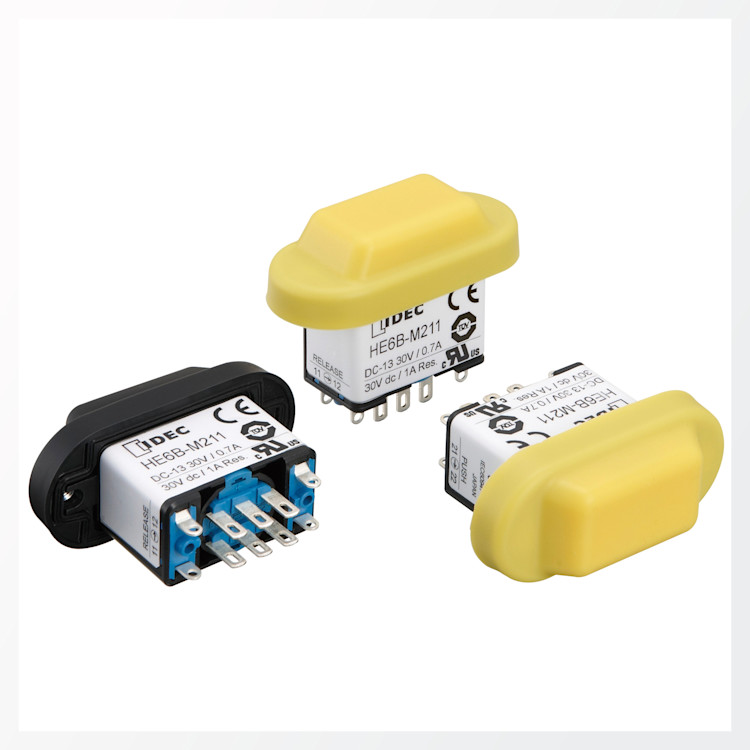
HE series 3-position enabling switches
Relevant standard: IEC 60947-5-8
An enabling switch is a unique safety device that differs from a hold-to-run switch. In general, standard switches such as hold-to-run switches only have 2 settings (positions): ‘on’, and ‘off’. They operate only while held in the ‘on’ position (1 of 2 positions).
A 3-position enabling switch has an ‘off-on-off’ configuration. It ensures safety by allowing machine operation (placing it in a standby-ready state) only while it is maintained in the ‘on’ position (the 2nd of 3 positions).
The extra ‘off’ position accounts for human nature – a fail-safe against unconscious reflexes in unexpected situations.
The switch must be deliberately gripped with a steady amount of pressure to remain ‘on’ (in the 2nd position). In an emergency, the operator may react by gripping the switch more tightly (pushing it to the 3rd position), or by releasing it completely (returning it to the 1st position) – in either case, the switch turns ‘off’.
This structure makes it possible to cover safety over a wider range than standard two-position switches.
We also design our 3-position enabling switches with strong consideration for ergonomics.
X series emergency stop switches
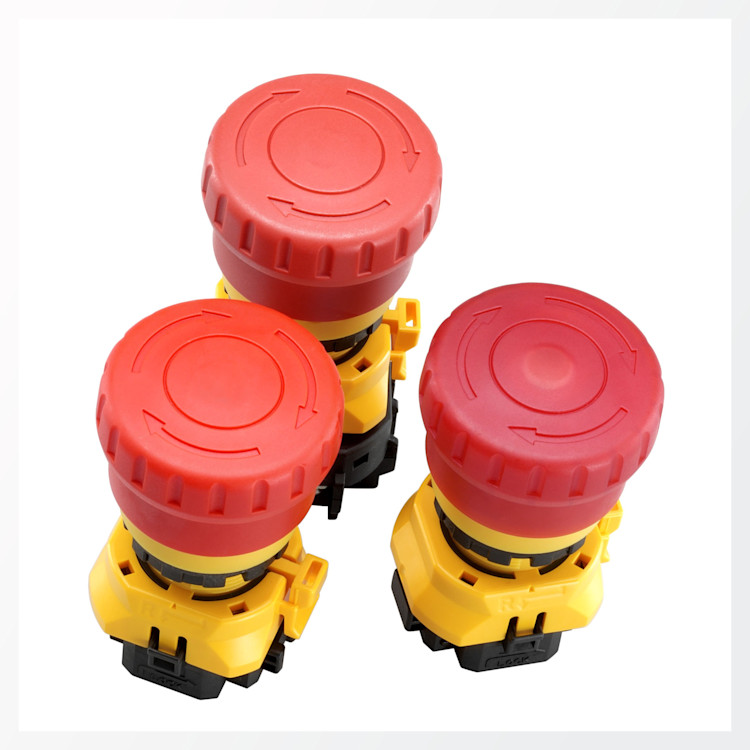
Relevant standard: IEC 60947-5-5
The safety requirements for e-stops are so ingrained in the public consciousness that the instantly recognizable colors and design of our switches go without saying. A green status indicator part, visible from the side, also makes it clear whether the switch is pressed (latched) or not.
The safety lock mechanism, direct opening action mechanism, short-circuit protection, and the degree of water/dust protection for IDEC X series e-stops also meet the requirements of related IEC standards.
More recently, our illuminated short-body emergency stop switches (XA/XW series) have been developed to also comply with the optional illumination requirements specified by international standards. The status of the emergency stop function – whether active or inactive – can be clearly identified at a glance by the button’s illumination color, which changes to red (active).
FS1B safety controller
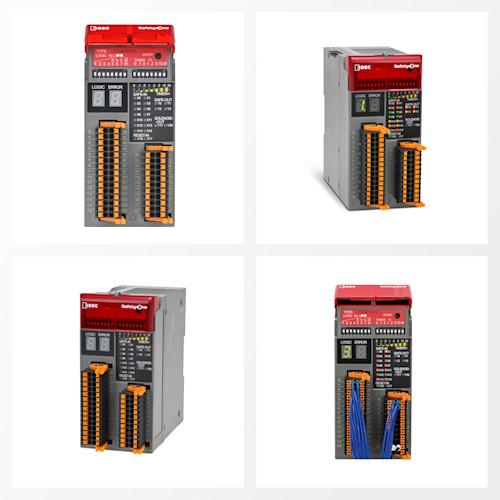
Relevant standards: IEC 62061, IEC 61508 (parts 1 to 7)
Functional safety in a control system is achieved through several steps, starting with an initial risk assessment. When designing the safety-related parts of a control system, a safety controller is the logical choice to keep systems streamlined and protected.
The FS1B comes with 24 pre-loaded, pre-certified safety control logics. The logics themselves meet international standards for functional safety, and give users pre-set configuration options including partial stop control, mode switching, and muting.
All outputs from the safety controller are safety outputs. Alongside the safety inputs, logics can be configured to include reset inputs and external device inputs for system monitoring.
SE2L Advanced safety laser scanner
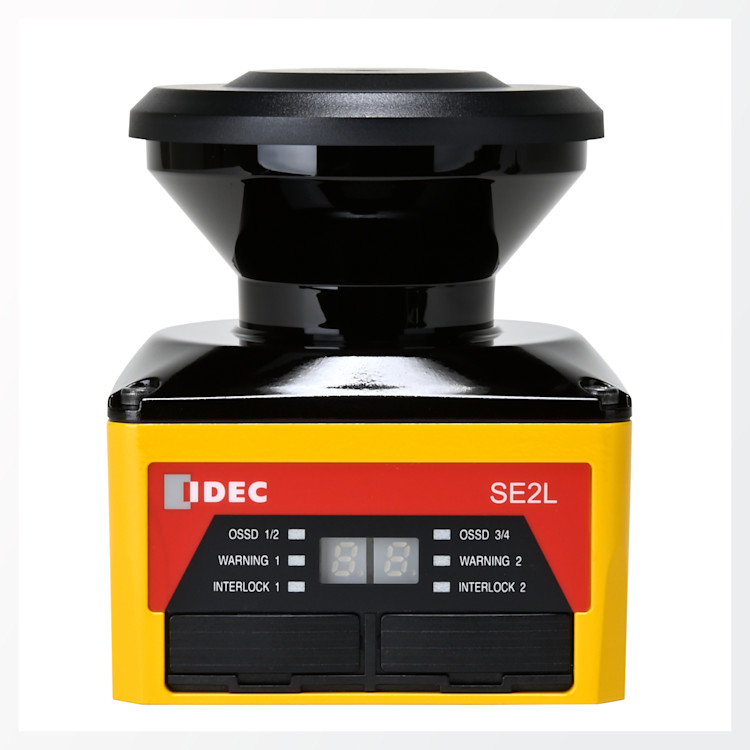
Relevant standards: IEC 61496-3, IEC 61496-1, IEC 61508 (parts 1 to 7)
In work environments where humans are always close to robots, machinery, and other hazardous areas, a safety laser scanner – positioned effectively – constantly works to prevent collisions and injury.
Set up detection zones (a warning zone and a protection zone) with simple area configuration software. The SE2L Advanced has a 270-degree wide sensing angle, and can be configured to cover 2 separate protection zones and replace up to 2 light curtains (monitor up to 2 areas).
If the SE2L Advanced detects a human or object in the warning zone, it’ll signal the hazard (e.g. an AGV/AMR, robot arm, etc.) to slow down. If a human or object is detected in the protection zone, the scanner signals the hazard to come to a complete stop.
Looking forward to the next 100+ years of industrial, technological and safety developments – keeping global standards relevant, and raising the bar
We provide a wide range of help and resources:
If you have questions or suggestions, we're here to listen.
Our sales and support teams are on hand to help.
All the technical documentation you need.