
What is a safety relay module/safety controller? | USA
Safety relay modules and safety controllers are devices used in the safety-related part of control systems. They implement controls, so that machines and equipment are only allowed to run when safety is confirmed.
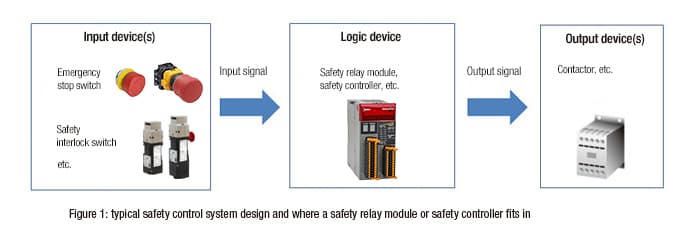
These devices specifically check the signals from input devices, such as emergency stop switches and safety interlock switches, to determine the safety level. They then control contactors and other connected output devices based on the results.
In other words, safety relay modules and safety controllers play a central role in control systems, acting as the logic unit in the safety-related part of the system (as shown in figure 1).
Safety relay modules
A typical safety relay module contains an electrical circuit, with several force-guided relays and other electronic components, and is installed in an enclosure. It is also designed for installation on a DIN rail (within a control panel).
How safety relay modules/safety controllers work in the safety-related part of a control system
First, an explanation of how the safety-related part of a control system works overall.
The system shown in figure 2 has a safety function where a contactor opens and closes the power supply circuit for the electrical load (motor) based on actuation of an emergency stop switch. If the emergency stop switch is pressed while the motor is running, the motor is immediately stopped.
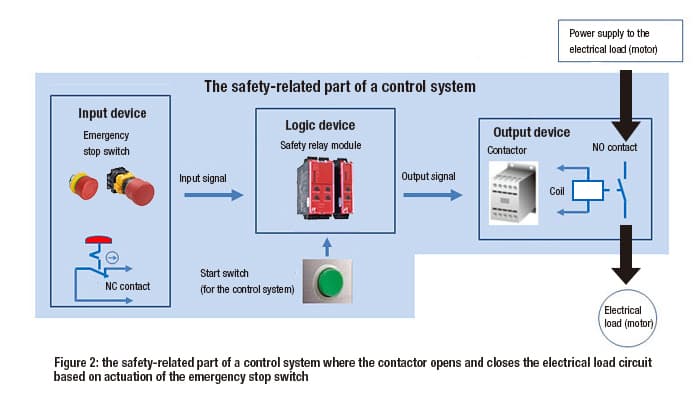
Emergency stop switches use ‘normally closed’ (NC) contacts, which are closed (ON) by default and transmit a signal to indicate a safe state (a safety signal). However, if something happens and the emergency stop switch is pressed, the NC contact opens (OFF), and the safety signal is no longer transmitted.
When the safety relay module or safety controller is receiving a safety signal from the emergency stop switch and the start switch for the control system is subsequently pressed, the module/controller transmits a signal to the contactor that allows the motor to run.
When the contactor’s contact is closed (ON) and power is being supplied, the motor will start running. Note that the contactor has a ‘normally open’ (NO) contact, which is open (OFF) where there is no signal from the safety relay module or safety controller.
In this type of safety control system, if the emergency stop switch is pressed while the motor is running then the safety signal is no longer received by the safety relay module or safety controller. The module or controller then stops transmitting the signal that allows the motor to run to the contactor. In response, the contactor’s NO contact also opens (OFF), and the motor stops.
In addition, once the emergency stop switch has been pressed, the safety relay module or safety controller does not transmit a signal to the contactor even if the start switch is pressed. As a result, the motor is unable to run.
To restart the motor, the emergency stop switch needs to be reset (released from its active state), and then the start switch must be pressed separately.
Safety controllers
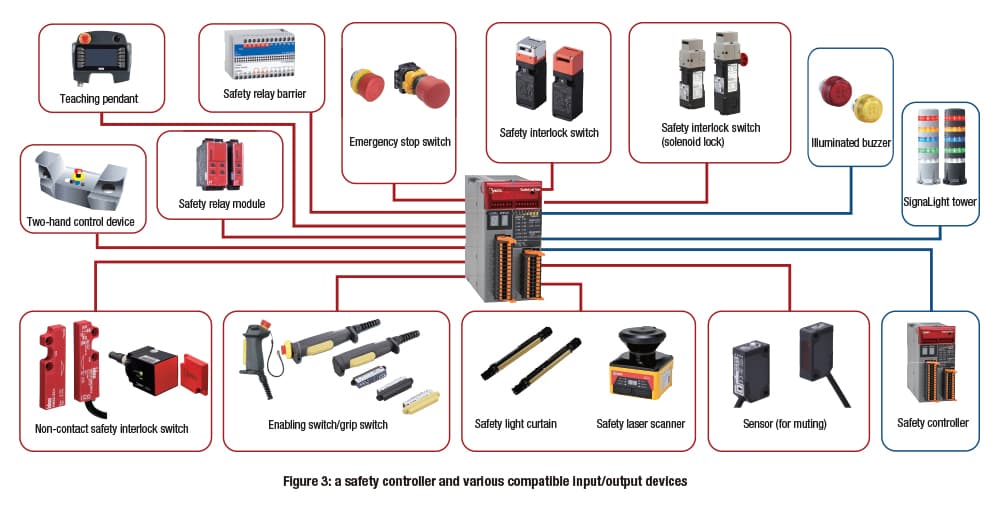
The safety controller is a device that, similarly to a safety relay module, can serve as the logic device in the safety-related part of a control system.
As the functionality of machines increases and new safety devices enter the market, the safety-related part of control systems is becoming more complex. A safety controller combines a high level of safety performance with ease of use. With the CPU functionality, it is easy to set up the logic processing and combination of safety devices required to ensure machine safety (as shown in figure 3).
IDEC safety relay modules and safety controllers
We provide a wide range of help and resources:
If you have questions or suggestions, we're here to listen.
Our sales and support teams are on hand to help.
All the technical documentation you need.