
IDEC Safety Concept | EMEA

IDEC's fundamental safety policy
IDEC released its first safety control product in 1950. We have used our safety technology and knowledge to contribute to the prevention and reduction of accidents and disasters at work for more than three-quarters of a century.
The IDEC Group has embraced “management with respect for humanity” as the foundation of our Vision, Mission, and Core Values. We pledge to conduct our business activities in ways that contribute to society and the economy. Based on this core policy, we work to create a safe and comfortable environment within the IDEC Group and throughout society on a global scale. The IDEC Group is unrivalled in the pursuit of safety, and aspires to a higher level of safety in all business operations.
IDEC is working to achieve the highest level of safety and ANSHIN in the world. Our initiatives include promoting the new-generation safety concept “Safety 2.0”, and social implementation of safety-related equipment.
The evolution of methods to ensure safety
Our approach to ensure safety has evolved with the times.
The most basic approach is Safety 0.0, which relies solely on human attention spans and judgment capabilities to ensure safety. Put simply, this approach means that people try to ensure their safety by paying attention, even if potentially harmful hazardous objects are present.
However, humans make mistakes and machines fail. There are limits to safety measures that rely solely on human attention levels.
The Safety 0.0 approach is not enough to ensure safety if someone makes a mistake, or if a machine fails. As a result, the next evolution was a shift to Safety 1.0, which ensures safety from the machinery system design stage.
Furthermore, to achieve greater flexibility and higher productivity, we are transitioning to a new approach called Collaborative Safety (Safety 2.0). Under this approach, information is shared between humans, things (machines/equipment) and the environment, and optimal safety is ensured through their collaboration.
Method to ensure safety: how safety functions are implemented | Principle | Means | Key feature | Key safety principle | Classification in Safenology | |
Safety 0.0 | Human attention | Protect oneself | Education, training, management, work and production standards, work and production manuals | Focus on production | Work safety | People: the human aspect (humanities) |
Safety 1.0 | (Human attention) + technologies | Make machines and equipment safe | Inherently safe design, safeguards, safety controls, safety standards, safety rules | Focus on safety | Machinery safety | Things: The technological aspect (physical science) is included |
Safety 2.0 | (Human attention + technologies) | Ensuring safety through collaboration | Use of ICT technologies, information sharing | Improve both productivity and safety | Collaborative Safety | Environment: the organizational aspect (social science) is included |
Note: the information in the above table is quoted and adapted from an article on Collaborative Safety (Safety 2.0) by Professor Mukaidono in the November 2018 edition of Machine Design.
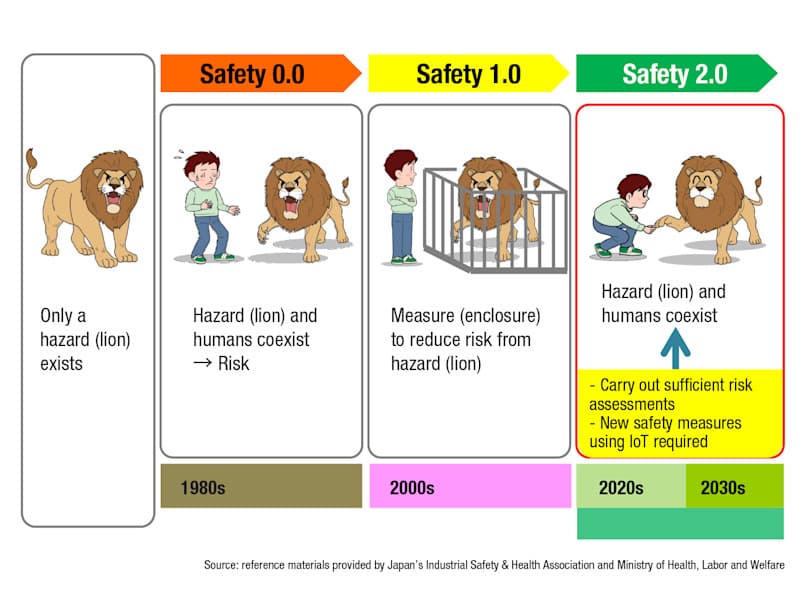
Compare a hazardous machinery system to a lion. If the lion (the machine) is by itself, with no humans nearby, there is no risk of harm.
Safety 0.0 represents a situation where a human and a lion exist in the same space. The only thing that can be relied on to prevent injury is human attention. The risk level in this situation is extremely high, and an accident could occur at any time.
Next is Safety 1.0, where safety is ensured by keeping the hazard (the lion) inside a cage, isolating it from humans.
Safety 2.0 aims to release the lion from the cage, to coexist in the same space as humans again. This is under the condition of conducting sufficient risk assessments and implementing new safety and ANSHIN measures.
A new approach to achieve a new concept of safety
Up to now, safety managers and safety engineers have incorporated the results of risk assessments and risk reduction measures (based on international safety standards) into machine systems to achieve the desired safety level.
However, the new concept (trend) of safety requires not only safety achieved by the control technology using safety devices, but also the following:
Developing personnel who drive a common understanding of safety among component manufacturers, equipment manufacturers and users,
Building systems that take occupational health and safety management into consideration,
Holding a strong commitment to preventing accidents, alongside users, and
Compliance with safety standards and other social rules for safety.
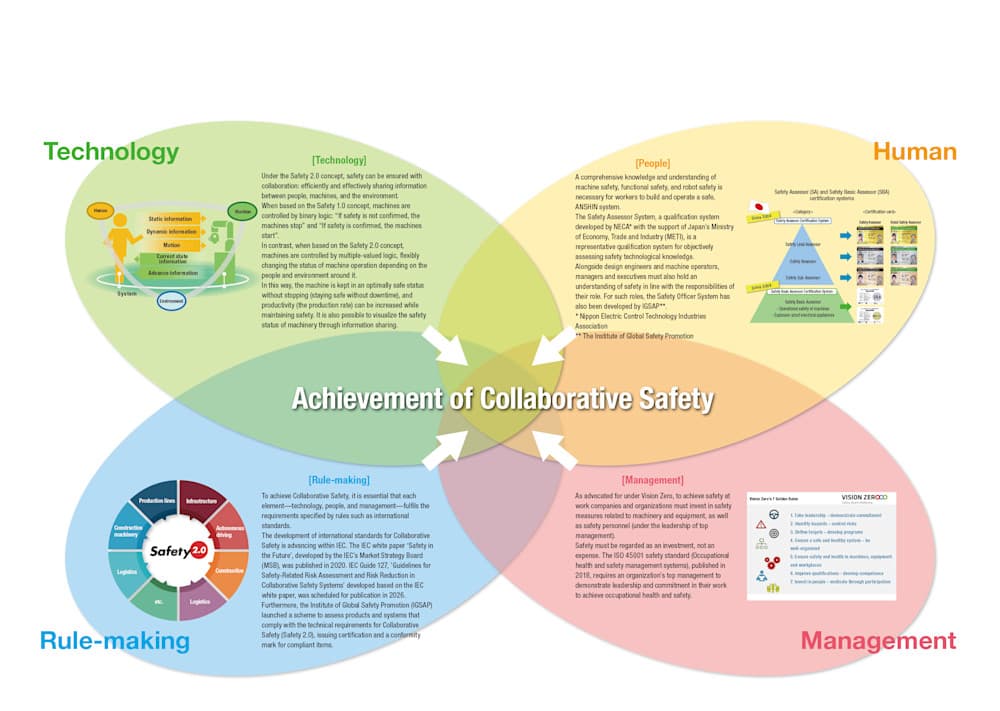
We must recognize that achieving safety is a highly efficient investment. Therefore, a holistic approach encompassing the following four aspects is required:
The technology aspect,
Human resources,
Management, and
Rule-making.
Working in a safe environment is a basic human right. This mindset is consistent with the Sustainable Development Goals (SDGs) advocated by the United Nations, and by Vision Zero* advocated by the International Social Security Association (ISSA) as part of the International Labor Organization (ILO).
(*Find out more about Vision Zero here.)
We provide a wide range of help and resources:
If you have questions or suggestions, we're here to listen.
Our sales and support teams are on hand to help.
All the technical documentation you need.