
Workplace safety for older employees: industrial automation and assistance technologies to support and empower workers in physically demanding jobs
Date: 16/01/2026 | By: IDEC HQ
Manual labor requires effort and takes a toll on the body at any age.
Manufacturing often involves many physical processes and stresses:
Standing in one place for a long time
Working in a tiring or difficult (e.g. uncomfortable, or painful) position
Lifting and carrying heavy loads
Pushing, pulling, bending, turning and stretching
As the working population gets older, they may not have as much strength or stamina to complete these demanding tasks.
This article covers:
The realities of an aging workforce in the manufacturing industry
The rise of robot workers and industrial automation and assistance technologies
The value of the experience and reliability older workers provide
The need to take ergonomics and physical limitations into consideration
The benefits of Assist Wheel Drive for manual handling of heavy loads
The realities of an aging workforce in the manufacturing industry
There are 2 key drivers behind the rising average age of workers in many countries:
Global governments increasing the national retirement age
Economic (financial) concerns leading people to keep working past the national retirement age
Research has suggested that by 2030, over 25% of workers in major global economies will be 55 or older. That’s roughly 150 million people worldwide – close to the entire working population of the US (as of 2025).
This shift will affect all industries. The effects have been felt in manufacturing for some time already – in the US, over-55s represented nearly a quarter of the industry’s workforce back in 2017.
As such, manufacturers are both very aware and very concerned about this trend. Working out what to do in response is a challenge for businesses of all sizes.

The rise of robot workers and industrial automation technologies
In jobs that require physical effort, older workers are at higher risk of musculoskeletal disorders and take longer to recover (on average) if injured.
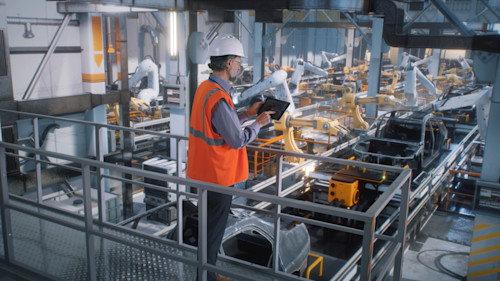
Robots and other automated solutions have begun to help automate physical processes in many industries. Repetitive manual tasks, such as picking up materials, moving them, and putting them back down, are relatively simple to program.
Industrial robots can lift and carry heavy loads without getting tired or taking a break. They aren’t at the same risk of physical injury or fatigue as humans.
Adopting them as part of the workforce feels logical, particularly for businesses and industries where the workforce skews older. A study from 2014 showed that industrial automation in manufacturing was already more common in countries with a higher ratio of workers over 55.
The value of the experience and reliability older workers provide
The introduction of industrial robots to do physically demanding work has taken literal stress and pressure away from workers. However, that’s been replaced with concerns that robots will eventually eliminate jobs for humans.
Collaborative robots are designed to operate safely in the same space as humans. Others can be programmed and trained to do a worker’s entire job on their behalf. In that scenario, a less efficient older worker may be surplus to requirements.
However, when humans leave jobs they take learned experience with them. A robot only ‘knows’ what it’s been designed to understand. It may not anticipate or adapt to change as effectively as a human would, or solve problems as quickly.
A skills shortage would put manufacturers – as well as other businesses – at risk of economic losses. Companies that are adopting robots on a wider scale need to ensure that the specialist knowledge an employee holds isn’t lost when they leave the workforce.

The need to take ergonomics and physical limitations into consideration
The amount of time someone remains in a physically demanding job can be uncertain. If an older worker postpones their retirement to help train others, a workplace injury caused by overexertion would quickly put them out of action.
People change as they get older: it’s a fact of life. This is equally true when it comes to their physical capabilities and their needs as employees over time – even if they remain in the same role for many years.
Companies must consider ergonomics and physical limits when trying to create an age-inclusive work environment. Physical changes associated with aging include reduced muscle strength, lower endurance, and limited flexibility. When ergonomics aren’t optimized for the worker, that person will get tired more quickly – leading to a sharp drop in productivity.
As part of Industry 4.0 and increased adoption of industrial robots, some advances in automation are helping to support workers rather than replace them.

Assist Wheel Drive: electric assistance for manual handling
For example, the Assist Wheel Drive (AWD) electric-powered wheel system was designed to prevent musculoskeletal disorders. It’s fully compliant with ISO 11228-2 (Ergonomics – Manual handling, part 2: Pushing and pulling).
The AWD system can be fitted to existing trolleys that users are already familiar with. After some practice, installation (by 2 people) can take as little as 10 minutes.
Once workers are trained to install AWD, they’ll find it even simpler to use. The ergonomic design includes a choice of controller styles for ease of use. Each controller has a thumbwheel, enabling forward and reverse operation with a hand movement – no need to exert any force with the shoulders, back, or hips.
Use Assist Wheel Drive to create a more supportive working environment
Transporting heavy loads with AWD significantly reduces physical stress and the risk of muscle strain and other injuries. The EW1A series AWD 150 can help workers move a maximum transferable load of 1,000kg (per wheel).
The AWD system’s ergonomics and convenience offer many advantages for companies seeking to retain and support their aging workforce. The direct benefits for employees who use AWD in their work are clear from our customer case studies.
You can explore the advantages of the Assist Wheel Drive system in more detail online, then contact your regional IDEC sales team to arrange a demo.
We provide a wide range of help and resources:
If you have questions or suggestions, we're here to listen.
Our sales and support teams are on hand to help.
All the technical documentation you need.