
When implementing a smart manufacturing system, an IoT-enabled PLC is the brains behind your operations
Date: 11/14/2024 | By: IDEC HQ
Every business wants to work ‘smarter’ to stay competitive in their field. That could mean streamlining their processes, using project management systems, or making the most of automation tools.
In industrial settings, a smart manufacturing system can reduce labor costs, improve product quality control, lower the risk of accidents, and prevent wasted energy and resources.
These wide-ranging advantages mean that the adoption and use of smart manufacturing is growing rapidly on a global scale. The automotive, food and packaging, semiconductor and construction industries are leading the way, transforming their facilities into ‘smart factories’.
The shift towards the smart factory model is led by a familiar piece of equipment: programmable logic controllers (PLCs). They continue to play a vital part in industrial automation, and can support smart manufacturing systems with forward-thinking features.
What makes a manufacturing system ‘smart’?
In the context of Industry 4.0, ‘smart manufacturing’ means using digitalization and modern technologies to make basic manufacturing processes even more efficient.
Importantly, those technologies (sensors, data analytics, the IoT and IIoT, robotics, automation, AI, machine learning and more) are built into the system from the start.
Other, more traditional manufacturing models have fixed systems that are harder to change and upgrade in response to technological advances. Digital integration is limited as a result, and replacing individual parts of the system is only a temporary solution.

Instead of OT vs. IT thinking, the IoT (and IIoT) can bring them together
Traditional production models rely on operational technology (OT) architecture – human control and monitoring of devices and processes, and of the systems needed to run them. Robots, safety systems, PLCs, lighting controls, programming software, and scientific/technical equipment are all examples of OT.
They can all be supported by information technology (IT) – data and cloud application management.
Companies may see their IT system as separate to their manufacturing system, only relevant to emails, accounting, and other back-end information processes. However, technological advances mean that IT’s focus on data and OT’s focus on equipment are far more effective when combined.
The fusion of OT and IT can create even greater possibilities than ever before, thanks to the Internet of Things (IoT). A network of connected devices sharing data is maybe the best example of how well they work together.
The role that the IoT plays in smart manufacturing is to facilitate full system integration. Device compatibility is no longer an issue. Access to real-time information enables more responsive – and even proactive – decision making.

How and where a PLC fits into a smart manufacturing system
PLCs act as the hubs of modern industrial automation systems. As physical devices, they are central to OT architecture.
The latest PLCs can do far more than just control and monitor equipment. They integrate and communicate with other systems, gather data, and provide visualizations and analytics to help operators make key decisions.
Of these functions, it can be argued that connectivity and data collection are the most important – to smart manufacturing, to the IoT, and to Industry 4.0 overall. Many devices can now supply large amounts of operating data. The PLC that receives this information has to be able to handle, interpret and display it effectively.
A PLC is the brain of a smart manufacturing system, and the Industrial Internet of Things (IIoT) becomes the backbone. The data collected from connected devices is shared throughout the system. The PLC can be programmed to analyze and present this information in the most suitable way for the specific application.
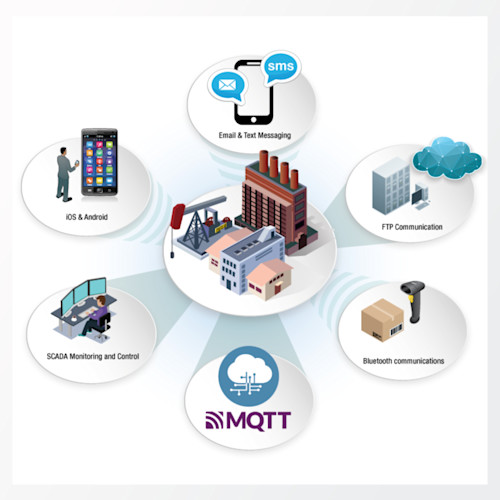
IDEC FC6A Plus: an IoT-enabled PLC with numerous smart features
IDEC PLCs can provide the integrated IoT functionality needed to implement a smart manufacturing system. As one example, the FC6A MicroSmart Plus PLC has a variety of clever built-in features:
Scalability of digital/analog I/O points: up to 2,060 I/O points (up to 511 analog I/O points) (when using expansion modules)
IIoT ready: dual Ethernet ports, compatible with open network protocols such as EtherNet/IP, Modbus TCP, and BACnet/IP
MQTT Sparkplug B
Reliable data handling: more than double the memory capacity of a standard micro PLC
E-mail notification: e-mail instruction can be used for alerts when a connected device causes an error
The FC6A Plus makes it simple to combine OT (connected devices) and IT (data transfer and management). Over 800kb (100,000 steps) of program memory and fast basic instruction processing and execution speeds ensure reliable responses to user needs and system changes.
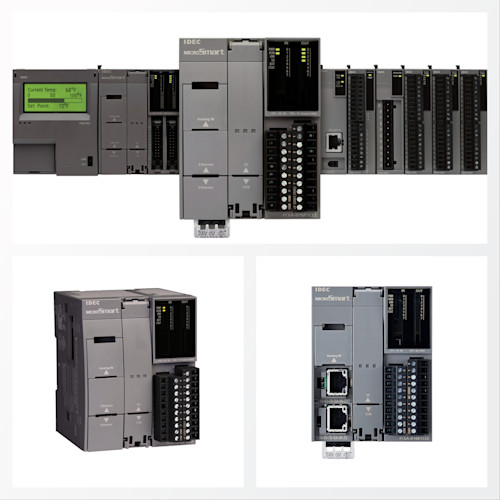
Consider building your smart manufacturing system around an IDEC PLC
Even as smart factories evolve, they continue to revolve around PLCs with IoT integration and strong adaptability. Read more about the FC6A Plus and our other IoT-enabled PLCs here on the IDEC website.
We provide a wide range of help and resources:
If you have questions or suggestions, we're here to listen.
Our sales and support teams are on hand to help.
All the technical documentation you need.