
What is an emergency stop switch? | Canada
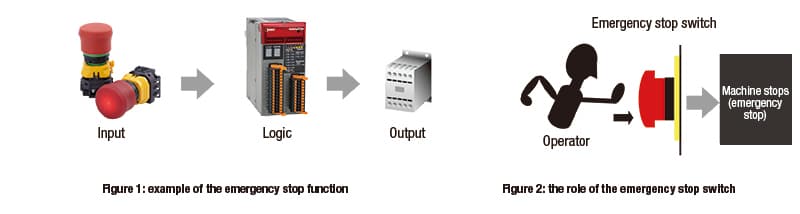
Machinery and equipment used at factories and other facilities are equipped with an emergency stop function. It stops the machinery and equipment in an emergency, ensuring operator safety as a complementary protective measure (see figure 1).
The emergency stop switch is the input device installed to carry out this function. The switch is manually pressed by a human (the operator) when they sense danger, if there is an issue with the machinery/equipment or workpiece, or if they feel there is a risk of damage/harm (see figure 2).
Design requirements for emergency stop switches
Button color and shape
There are various pushbuttons and indicators on a machine’s control panel. In an emergency, the emergency stop switch must be easy to find and immediately operable.
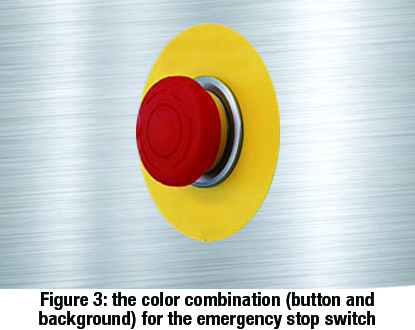
For this reason, the button must be red and shaped to be easily pressable with the palm of the hand. In addition, the background color of the switch must be yellow.
This color combination – a red button on a yellow background – is eye-catching, in order to help the operator recognize the switch in an emergency situation (see figure 3).
Normally Closed (NC) contacts
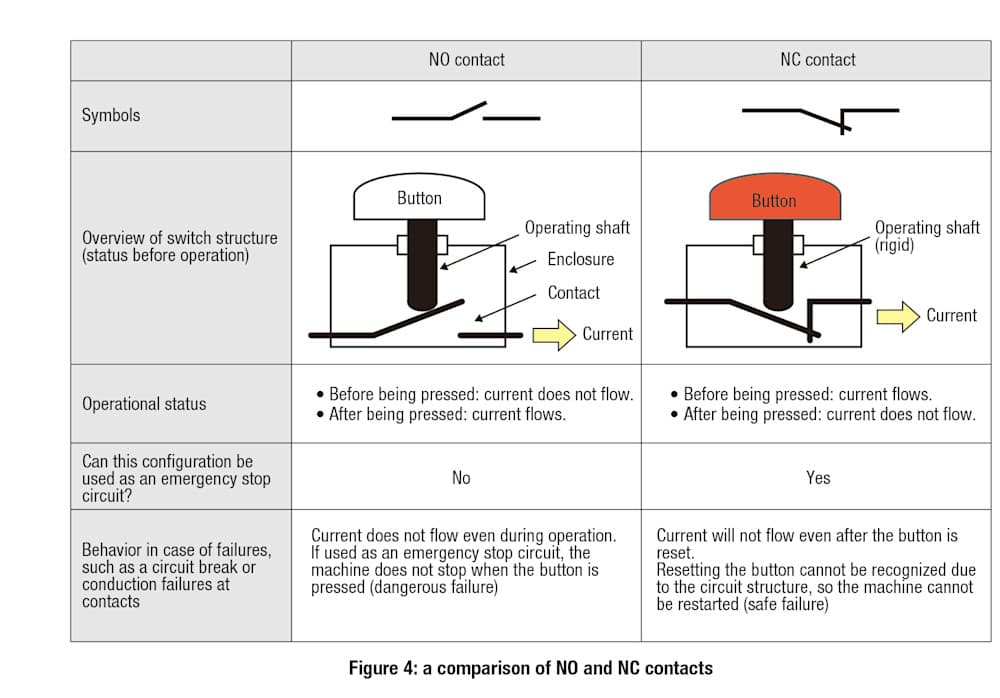
There are two contact types used in switches: ‘normally open’ (NO), and ‘normally closed’ (NC) (see figure 4). To comply with the safety principles specified in regional and international safety standards, emergency stop switches must use NC contacts. The reasons for this are as follows:
Suppose the emergency stop switch is mistakenly designed with a NO contact (as shown on the left-hand side of figure 4).
In that case, when the button is not pressed (not an emergency), the NO contact is open and no current flows through the circuit. When the button is pressed, the NO contact closes and current flows through the circuit to signal the emergency state. This causes an emergency stop of the machinery/equipment.
However, if there is an issue with the circuit, such as a foreign object attached to the NO contact or a disconnected wire, no current will flow through the circuit. This results in a “dangerous failure”, where the machinery/equipment cannot be stopped in an emergency even if the button is pressed.
On the other hand, if the switch is designed with an NC contact (as shown on the right-hand side of figure 4), the contact is closed when the button is not pressed. When the button is not pressed (not an emergency), the NC contact is closed, and current flows through the circuit. Then, when the button is pressed, the NC contact is opened – interrupting the current and bringing the machinery/equipment to an emergency stop.
In other words, the signal from the emergency stop switch functions as an emergency stop output by interrupting the current (an indicator of a safe operating status). In this case, if there is an issue with the circuit, such as a foreign object attached to the NC contact or a disconnected wire, the current will not flow through the circuit. This results in a “safe failure (non-dangerous failure)” that prevents the machinery/equipment from running.
As explained above, when there is an issue with the circuit the NO and NC contacts have entirely different failure states.
From a safety perspective, which type of failure is more ideal?
The devices used in safety-related parts of control systems, such as emergency stop switches, are required to perform a safe failure, i.e. stop the machine in the event of their own failure. International safety standards require NC contacts to be used for emergency stop switches for this reason.
Direct opening action
Direct opening action is a function that reliably transmits the force of pressing the button as the force needed to open the NC contact.
Even if the contact is welded shut, pressing the button can still be relied upon to open the NC contact. (a state where the contact surface melts, then cools and becomes stuck, due to an inrush current exceeding capacity when the contact is opened or closed.)
Because of this function, to achieve contact separation the parts of an emergency stop switch from the button to the contact must be “non-resilient members” (e.g. not dependent on springs) as per IEC safety requirements (as shown on the right-hand side of figure 4).
Flexible parts, such as springs, cannot transmit the force needed to press the button. If one of these flexible parts is damaged, it is no longer possible to open the NC contact by pressing the button.
Latching mechanism (self-holding mechanism)
Emergency stop switches are normally used in an emergency situation. As such, when the button is pressed the NC contact opens to interrupt the current. At the same time, a latching mechanism activates to hold the button in the “pressed down” position until reset by a separate manual action. This enables interruption of the current to continue, preventing the machinery or equipment from unexpectedly restarting.
After confirming the safety status, there are two primary ways to release the latch and return the button to its original position (resetting):
By turning the button in a specified direction (turn-reset type)
By pulling the button back to its original position (pull-reset type)
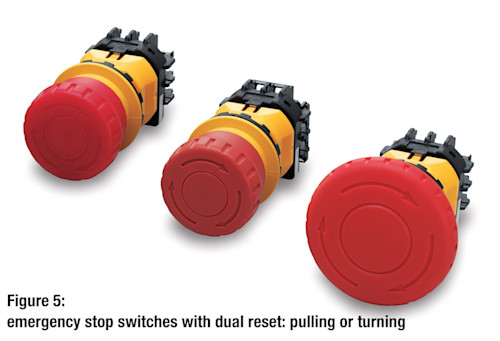
The preferred reset type varies depending on the region, industry sector, application, etc. As a result, there are dual-reset type emergency stop switches that can be reset with a turn or pull. These can be used in any region, industry sector, application, etc. (see figure 5).
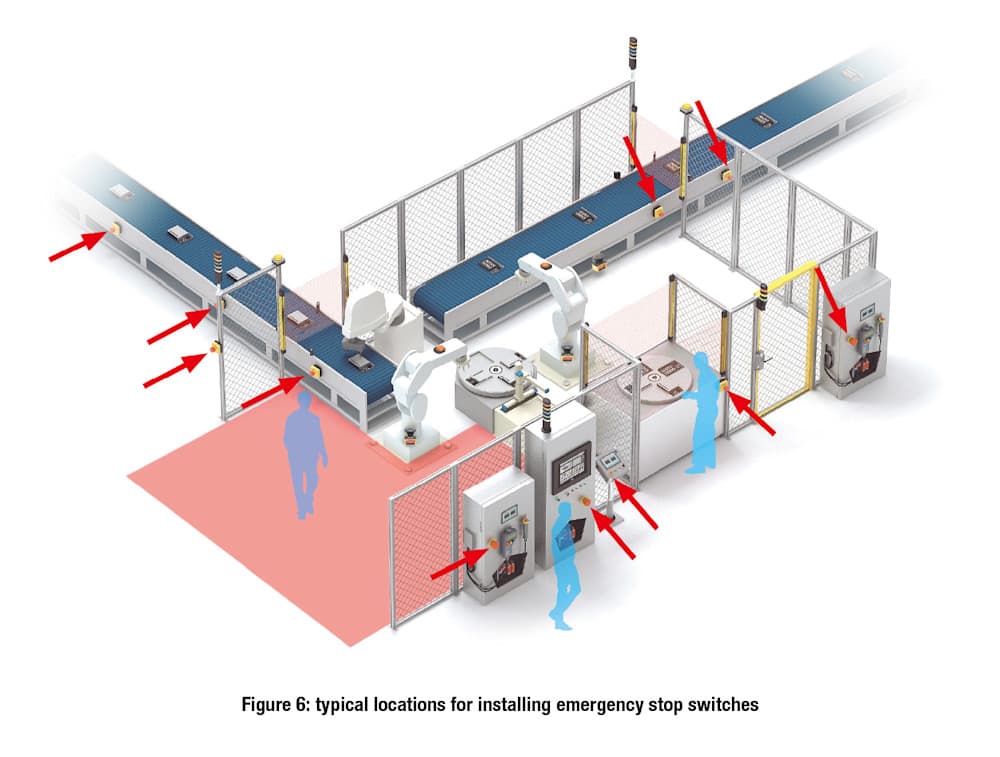
Locations of emergency stop switches
Regional and international standards require that emergency stop switches shall be located in the following places:
Each operator control station (except where the risk assessment indicates that this is not necessary)
Locations determined as a result of the risk assessment, for example:
- Entrance and exit locations
- Locations where intervention with the machinery is needed, such as operations with hold-to-run control and enabling control
- All locations where human-machine interaction is expected, such as loading/unloading zones
Emergency stop devices shall be positioned so that they are directly accessible and capable of non-hazardous actuation by the operator and others who could need to actuate them.
IDEC X series emergency stop switches
We provide a wide range of help and resources:
If you have questions or suggestions, we're here to listen.
Our sales and support teams are on hand to help.
All the technical documentation you need.