
Production Line Safety | Canada
Flat loading surfaces and safe operation for automatic guided vehicles (AGVs) with a single illuminated buzzer
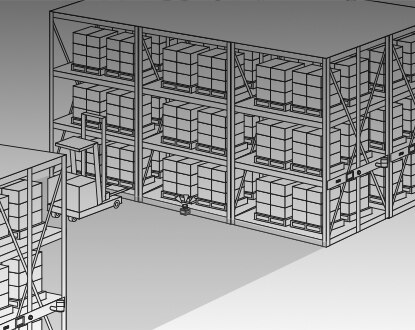
Demand for low profile AGVs at production sites is increasing
Automatic guided vehicles (AGVs) are often used to automatically transport objects inside factories. They have increasingly been used to transport products between processes as an alternative to conventional belt conveyors, and their use is expected to become even more widespread. Among the various types of AGVs, low profile models with a flat upper surface are used for a wide range of applications such as transporting baskets of various sizes and pulling trolleys. We expect that demand for this type of AGV in particular will continue to rise.
AGV manufacturers conduct extensive R&D to deliver low profile models to their customers. Even so, they are facing the particularly tough problem of developing models that have a low profile without sacrificing their safety and practicality. In order to notify surrounding workers of the AGV's operating state, conventional AGVs are generally equipped with devices such as tall signal light towers, buzzers, and speakers that reliably alert workers even when the AGV is fully loaded.
It is difficult to install vertical signal towers when designing vehicles with strict height limitations. Even if they are installed at the front or rear of the vehicle, they can block the installation of other components such as emergency stop buttons, or the lamps may become difficult to view. This causes various safety and design problems.
This type of issue is problematic for AGV manufacturers who want to fulfill customer requests for low profile vehicles without sacrificing practicality and safety.
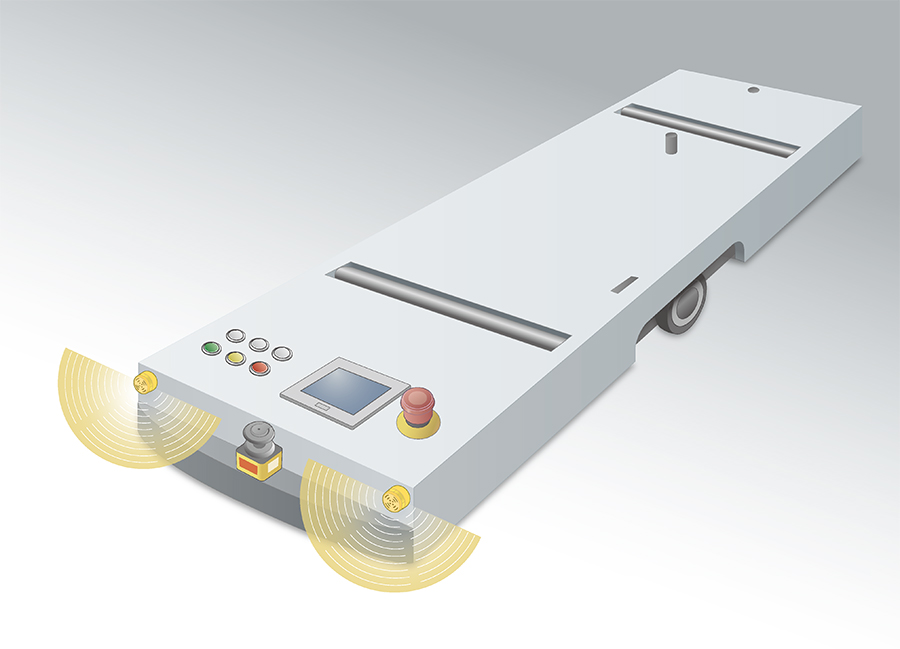
A single illuminated buzzer allows low profile AGVs to operate safely
IDEC has developed a solution to this problem. Instead of using conventional signal towers, this solution involves installing the HW1Z illuminated buzzer at the front of the AGV to alert surrounding workers using both light and sound.
As the buzzer is attached to the front of the vehicle, it emits light and sound in the direction of travel. This ensures that surrounding workers are reliably notified, and maintains a sufficient level of safety.
The HW1Z has a small diameter of 30 mm, enabling the vehicle to have a low profile and ensuring practicality. This is not possible with conventional signal towers. As the HW1Z can be wired using push-in terminals that eliminate the need for screws and tightening, it can be used with AGVs where wiring terminals may become loose due to vibration. As the demand for AGVs is expected to increase, users will demand models that are more compact and lower to the floor. This will further increase the need to miniaturize components.
The HW1Z will not only satisfy future demands, but will reduce costs and labor. Its 22mm mounting diameter is extremely common, compatible with a wide variety of devices and simple to work with. As such, we believe this solution will be beneficial to AGV manufacturers and users alike.
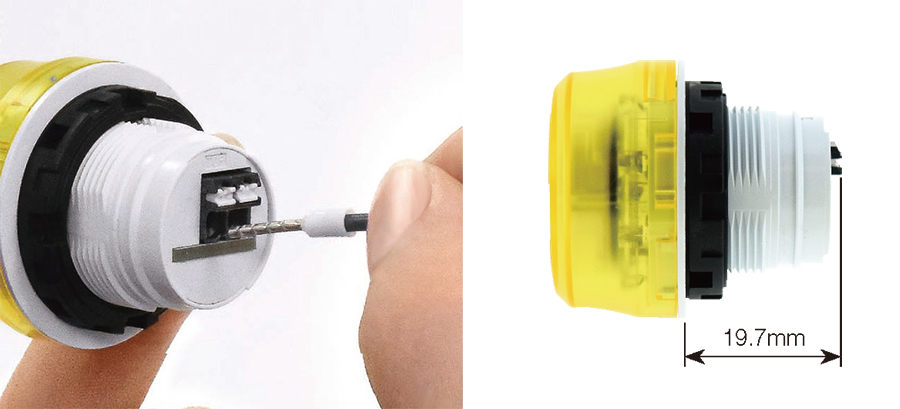
A wide range of products suitable for various AGV designs
Alongside pilot lights and buzzers, IDEC offers a range of products that can add value to AGVs.
As one example, the HG1G operator interface with a compact 4.3-inch display has FTP server functionality for file transfers. Simply connect to a network and maintenance and display updates can be done remotely, improving efficiency at production sites.
We also have a comprehensive lineup of switches, such as control switches and emergency stop switches in a variety of designs and sizes. The range is designed to suit a wide range of applications, and we will support you in finding the ideal solution.
We provide a wide range of help and resources:
If you have questions or suggestions, we're here to listen.
Our sales and support teams are on hand to help.
All the technical documentation you need.