
How ISO-compliant equipment, devices and systems enhance and assure long-term industrial safety (part 1)
Date: 07/02/2025 | By: IDEC HQ
Manufacturers who focus on safety compliance, international standards and certification aren’t just doing it for show. There are wide-ranging advantages of ISO compliance at every stage of the manufacturing process.
Ensuring operational compliance and worker safety is vital for businesses to meet regulatory requirements and industry benchmarks. For those in charge of maintaining compliance levels, it can also be seen as a moral responsibility.
International safety standards, set by independent regulatory bodies such as the International Organization for Standardization (ISO), provide robust frameworks and clear guidelines for businesses to follow.
In the first part of this 2-part series, learn more about the history of the ISO and how global safety standards have changed with the times. We also provide some insights into how important ISO-compliant equipment can be in industrial settings.
In this article:
ISO standards and their lasting positive impact on industrial safety
The wide-ranging benefits of using ISO-compliant equipment
The challenges involved in meeting global safety standards
Examples of IDEC products that meet specific ISO safety standards
How IDEC strategically uses ISO compliance to achieve safety, security, and well-being
ISO standards and their lasting positive impact on industrial safety
The ISO was officially formed in 1947 and created its first standard in 1951.
ISO safety standards cover almost every aspect of manufacturing, technology, and management. There are over 25,600 standards as of November 2024. New standards are developed by 800+ technical committees and sub-committees.
ISO releases updates to standards on a regular basis, to reflect advances in technology and societal changes. For example, ISO 14001 – the first standard for environmental management systems – was released in 1996 in response to concerns about climate change. ISO revised the standard in 2004, and again in 2015.
Workplace safety has also come to the forefront over time. Measures to foster a culture of safety in the workplace have grown to encompass more than just physical protection. Employees who know they are always safe and secure in their work environment enjoy better mental health and well-being.
The universal acceptance and implementation of international safety standards puts them at the top of the regulation hierarchy. Businesses that comply with certain ISO standards can be certified by a third party, to demonstrate their commitment to safety. In some industries, this could be a contractual or legal requirement.
Importantly, ISO compliance and certification are not mandatory for all businesses in every country. However, the global reputation of ISO standards is so strong that non-compliance can damage industry/market competitiveness and consumer confidence.
The work needed to comply with ISO safety standards compels businesses to look closely at their current setup and identify weak points and risk factors. Any issues need to be addressed – and once compliance is achieved, it must be maintained.

Wide-ranging benefits of using ISO-compliant equipment
ISO standards are created to answer a simple question:
“What’s the best way to do this?”
ISO compliance signals that a business is following best practices for safety, agreed on by experts. When a business meets the requirements outlined by a specific ISO standard, they have achieved ISO compliance in that area.
Some standards are universal: quality management, IT security, occupational health and safety, sustainability, etc. Some of them can be applied to equipment and devices, and to systems.
If a system contains a technology or function covered by an ISO standard, that part of the system can be assessed and judged as compliant. There are safety standards for pressure-sensitive devices, emergency stop functions, interlocking devices, collaborative robots, AGVs/AMRs, and many other industrial safety devices.
Depending on the standard, meeting it can lead to several business advantages:
comprehensive risk management
improved hygiene and food safety levels
increased data security
higher operational efficiency
fewer workplace accidents and injuries
lower pollution and waste levels
cost savings
The challenges involved in meeting global safety standards
The first hurdle in meeting an ISO safety standard is correctly understanding the requirements.
ISO ensures that its standards are worded to be easily understood by all. Key technical terms are defined at the start, and the ISO ‘house style’ is based on Plain English.
At the same time, standards are comprehensive in their scope. Finding the relevant sections and working out what needs to be done can take time.
After that, implementation presents other challenges, such as:
working with limited time and resources
replacement and disposal of non-compliant equipment
investments in and installation of compliant equipment
employee training and skills development
sustaining commitment and motivation levels
These efforts are worth it in the long run – it’s important to remember that achieving ISO compliance isn’t a one-time event. ISO standards are worded to encourage businesses to actively monitor and ensure their ongoing compliance levels.
Examples of IDEC products that meet specific ISO safety standards
IDEC constantly works to ensure that our products and processes achieve ISO compliance and keep customers safe.
IDEC ISO-compliant products include:
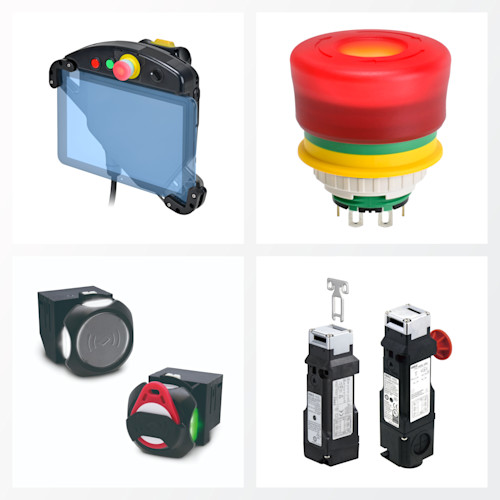
HT3P and HT4P Safety Commander: ISO 10218-1 (Robots and robotic devices – Safety requirements for industrial robots, Part 1: Robots), ISO 10218-2 (Robots and robotic devices – Safety requirements for industrial robots, Part 2: Robot systems and integration)
XA/XW series emergency stop switches: ISO 13850 (Safety of machinery – Emergency stop function – Principles for design)
KW2D RFID reader: ISO/IEC 14443 series (Cards and security devices for personal identification – Contactless proximity objects)
HR series safety relay modules: ISO 13849 (Safety of machinery – Safety-related parts of control systems)
HS series safety interlock switches: ISO 14119 (Safety of machinery – Interlocking devices associated with guards – Principles for design and selection)
EW2A (Safety Wheel Drive): ISO 3691-4 (Industrial trucks – Safety requirements and verification, Part 4: Driverless industrial trucks and their systems)
As a company, we also comply with ISO 14001 (Environmental management systems), ISO 9001 (Quality management systems), and ISO 45001 (Occupational health and safety management systems).
Strategically using our ISO compliance to achieve safety, security, and well-being
IDEC has a dedicated International Standardization & Collaborative Safety Department. We actively contribute to the international standard creation process, from initial proposals to final decisions.
We take part in the development of ISO standards for industrial robots, AGVs/AMRs, and other relevant industry applications, as well as machine safety and functional safety.
We are also involved in proposing and formulating international standards for Collaborative Safety – which we see as the next generation of safety.
Through this work and more, IDEC aims to achieve safety, ANSHIN, and well-being for people around the world.
(ANSHIN denotes a sense of trust and assurance without any fear or stress. Well-being is a concept that denotes that individuals are in good physical, mental, and social condition, where one’s rights and self-actualization are realized.)
ISO compliance is the foundation of effective industrial safety systems worldwide
ISO is the gold standard for industrial safety. Businesses that comply with ISO standards – and develop products and services that comply with ISO standards – have the reputational advantage needed to compete on a global level.
More information about international safety standards, and specific ISO standards, is available on all of our regional IDEC websites.
We provide a wide range of help and resources:
If you have questions or suggestions, we're here to listen.
Our sales and support teams are on hand to help.
All the technical documentation you need.