
To calculate ROI on industrial safety equipment for your business, you should consider more than just the RRP
Date: 11/03/2025 | By: IDEC HQ
In our ROI calculation for the ez-Wheel Assist Wheel Drive system, we’ve suggested that some users could see a return on their investment in less than 1 year.
You may have some questions about that statement:
Would I really achieve return on investment (ROI) in under a year with Assist Wheel Drive?
How did you calculate that ROI? How should I calculate safety equipment ROI for my business?
What counts as ROI on safety equipment?
It’s natural for people to view and calculate ROI differently. For someone in the finance department, spending on safety equipment adds another line to the expenses list. For someone on the factory floor, the company is paying for their well-being and sense of security as they work.
Let’s take a closer look at ROI for safety equipment such as Assist Wheel Drive, and how to try and estimate it for your business.
When you invest in safety, try to put yourself in someone else’s work shoes
It’s important to class safety equipment purchases as ‘investments’, not as ‘expenses’.
The adoption, installation, and proactive maintenance of industrial safety equipment should be seen as a necessary, worthwhile investment in a facility and its workers.
All business managers understand this on some level – they’re human too, after all. However, when you’re comparing future savings to the cash you currently have on hand, making the initial purchase can feel harder to justify.

Measure the cost of solutions against the real-world cost of inaction
The true ROI for safety equipment is: the cost of doing nothing.
Businesses need to calculate how much an accident, malfunction or other workplace incident would actually cost, compared to how much the prevention measures will cost to implement.
This calculation should include as many factors as possible. There are always direct and indirect costs of an incident.
Those amounts depend on the industry, the severity of the incident, how many people it affects, how long it takes to resolve, etc. They could include:
Damage to facilities and machinery
Losses of productivity and data during downtime
Decline in output quality and quality control (wastage)
Failure to meet deadlines/commitments
Employee medical bills and compensation
Higher insurance premiums
Legal fees and fines
Employee turnover (loss of knowledge and expertise, labor shortages)
Loss of customers (temporarily or permanently)
Reputational damage
Factor in the many potential knock-on effects, and the real cost of inaction could be much higher than you first assumed.
Some research has shown that – regardless of industry – ROI on safety investments (accident and injury prevention) is double or higher.

Stop the risk of physical pain from becoming a business pain point for your employees
Assist Wheel Drive (AWD) can potentially offer you ROI within a short period of time. It’s ergonomically designed to prevent physical injuries in the workplace – once installed, the benefits quickly become clear.
As we’ve explained, the full cost of a worker being injured can quickly outpace the cost of keeping them safe from the start.
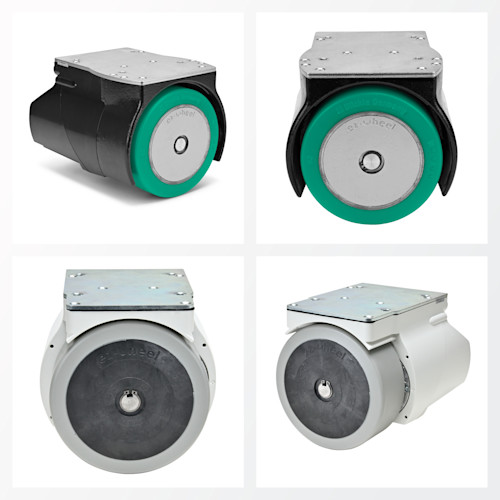
AWD brings electric power assistance to industrial trolleys. Each wheel is simple to install, can be retrofitted to existing trolleys, and can transfer a load of up to 1 ton.
Once fitted, the system greatly reduces the manual force a worker needs to use to move the load. Exerting too much of their own physical strength could result in a back sprain or strain – some of the most common workplace injuries.
AWD is compliant with the international safety standard ISO 11228-2, which defines recommended physical effort (pushing and pulling) limits for manual workers. The standard applies to tasks that involve lifting and transporting objects weighing at least 3kg, and is based on an 8-hour working day.
The effort and force limits set by ISO 11228-2 are measured in Decanewtons (daN):

Indicative value for handling trolley, with handles positioned at an average height of 95 cm from the ground, pushed by a male operator over a distance of 15 meters with a starting frequency of once every 5 minutes. (Caution: values may change depending on condition of use)
The push/pull force exerted by a worker quickly adds up, especially when transporting heavy loads. For example, the initial effort used to move trolleys weighing 300kg or more can soon reach or exceed 25 daN, depending on the trolley caster type, slope angle, and surface friction.
When using AWD, workers will feel less pressure on their musculoskeletal system: their bones and muscles, joints and ligaments, and other connective tissue. The AWD 150 Series provides 35 daN of pushing force on an equipped trolley, greatly reducing the amount of physical effort needed. (The AWD 160 Series provides 27 daN.)
Weigh up the cost of installing an electric power-assisted wheel against:
Sick leave for injured employees
Lost time and wages during treatment and recovery
Penalties for failing to meet workplace safety standards
A long-term decline in working speed and productivity
The ROI for your workplace becomes much clearer when you think about it in this way. We’re confident that AWD demonstrates strong value in industrial environments.
The advantages of safety equipment go far beyond their financial value
Cash cost is not – and should never be – the only factor in creating or upgrading a safety system.
Knowing the ROI of your investment in safety equipment is important, but the final decision should be based on a wider variety of business considerations.
The potential mix of financial and non-financial benefits includes:
More efficient and productive work processes
Longer working lifespan of machinery
Happier, more motivated employees
Increased compliance with laws, regulations, and international standards
Any issues are quicker and cheaper to resolve if they do occur
“You can’t put a price on safety.” – or on the health and well-being of workers
Effective safety measures are always worth the initial investment and more.
Contact IDEC for:
More information about Assist Wheel Drive
More information about other IDEC safety devices
Advice on adopting industrial safety equipment at your workplace
We provide a wide range of help and resources:
If you have questions or suggestions, we're here to listen.
Our sales and support teams are on hand to help.
All the technical documentation you need.