
How ISO-compliant equipment, devices and systems enhance and assure long-term industrial safety (part 2)
Date: 14/02/2025 | By: IDEC HQ
Safety is a top priority in every industry. In manufacturing, achieving relevant certifications and maintaining compliance with international safety standards is a competitive advantage, with positive impacts on and off the factory floor.
Safety standards set by the International Organization for Standardization (ISO) protect manufacturing facilities and workers worldwide. Compliance with ISO standards improves workplace security, efficiency, and health and safety.
In the first article in our series on ISO safety standards, we explained how these guidelines became the global benchmarks for compliance.
The next step is to look at the future influence ISO standards will have, as industrial safety systems and technologies continue to change with the times.
In this article:
The 5 safety compliance trends and considerations that will transform industries
1. Effects of automation
2. Robotics
3. Internet of Things (IoT)
4. Ethics of technology (AI)
5. Data privacy and cybersecurity
IDEC’s continued work to ensure ISO safety standard compliance
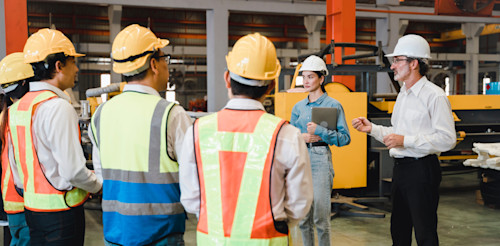
Safety compliance trends and considerations that will transform industries
As there are tens of thousands of ISO standards, multiple standards apply to each industry. When existing standards are revised and new ones are introduced, businesses must respond accordingly.
ISO looked at the future of standardization and compliance in 2022. It identified 15 ‘drivers of change’ – areas where societal and technological advances will further increase the need for global safety standards and guidelines.
Of those 15 ‘drivers of change’, we’ve listed 5 that will continue to affect safety requirements in industrial applications:
1. Effects of automation
The ISO notes that, as part of Industry 4.0, the number of machines that can outperform humans at specific tasks is rapidly increasing. Factory automation solutions are advancing at the fastest pace in recent history. ISO standards for automation may need to be revised more frequently to keep up.
Long-term studies and forecasts of this evolution note that automation will eventually create just as many jobs as it replaces, if not more. Safety compliance is integral to this cultural shift. Manufacturing sites will need workers with specialist technical skills to manage and troubleshoot their new automated systems.
Relevant ISO standards:
ISO/TR 23087 (Automation systems and integration – The Big Picture of standards)
ISO 3691-4 (Industrial trucks – Safety requirements and verification, Part 4: Driverless industrial trucks and their systems)
2. Robotics
The ISO singles out the automotive industry as a sector that will lead increases and advances in the use of industrial robots.
Changes in the automotive industry will affect both input and output. Robots can quickly increase production and efficiency levels at manufacturing sites.
The safe use of industrial robots is comprehensively covered by multiple ISO standards. The adoption of collaborative robots – a type of industrial robot designed to work alongside humans – has rapidly grown in recent years. So that these robots can safely operate in close range of workers, maintaining compliance with international standards for human safety is becoming a greater challenge for many companies.
Relevant ISO standards:
ISO 10218 series (Robots and robotic devices – Safety requirements for industrial robots)
ISO/TS 15066 (Robots and robotic devices – Collaborative robots)
ISO/TR 20218 series (Robotics – Safety design for industrial robot systems)
3. Internet of Things (IoT)
In 2022, experts predicted that an average Internet user would interact with IoT-connected devices nearly 4,900 times every day by 2025. This includes IoT in the workplace – also known as the Industrial Internet of Things (IIoT).
A typical IoT-enabled industrial safety system includes safety input devices, relays, a PLC or other host device, and safety output devices. Systems can be highly customized, including devices with wide-ranging capabilities. Japan was first to propose an international standard for IoT system lifecycle processes, one that covers IoT products and services: ISO 30147 (see below).
Before looking at ISO standards related to individual devices, businesses should start with the guidance for effectively integrating an industrial IoT system. A fully researched, well implemented system is easier to maintain, audit, adapt and enhance in response to changing requirements.
Relevant ISO standards:
ISO/IEC 30147 (Information technology – Internet of things – Methodology for trustworthiness of IoT system/service)
ISO/IEC 21823 series (Internet of Things (IoT) – Interoperability for IoT systems)
ISO/IEC 30162 (Internet of Things (IoT) – Compatibility requirements and model for devices within industrial IoT systems)
ISO/IEC 30165 (Internet of Things (IoT) – Real-time IoT framework)
4. Ethics of technology (AI)
For AI-related ISO standards to remain relevant on a global level, countries need to agree on ethical frameworks for using AI. According to the ISO and other sources, global agreements on ethical uses of AI will affect business automation systems, AGVs/AMRs, cobot training, and predictive maintenance.
This includes deciding when it would be unethical not to use AI. For example, in the healthcare and pharmaceutical industries, AI technology with the power to accelerate medical developments could save lives. The real-world impacts of AI, LLMs and other advanced technology make the decision more complicated.
Relevant ISO standards:
ISO/IEC TR 5469 (Artificial intelligence – Functional safety and AI systems)
ISO/IEC AWI TS 22440 series (Artificial intelligence – Functional safety and AI systems)
5. Data privacy and cybersecurity
There are concerns that the Internet of Things (IoT), safety sensors, and devices designed to collect and transmit data could all negatively affect personal privacy.
This is an issue that businesses handling personal data on connected devices need to consider. As one example, RFID readers grant workers access to facilities, areas and equipment based on customized authorization data.
Data security is already paramount in every industry. Businesses with water-tight personal data privacy policies enjoy higher levels of consumer trust and respect – privacy protection is now a competitive advantage.
Gaining the same level of trust from employees enhances workplace well-being. This has the added effect of improving worker focus and productivity levels, driven by their strong peace of mind.
Relevant ISO standards:
ISO/TR 22100-4 (Safety of machinery – Relationship with ISO 12100, part 4: Guidance to machinery manufacturers for consideration of related IT-security (cyber security) aspects)
IDEC continues to work to ensure ISO safety standard compliance
The ISO sets clear benchmarks for industrial safety that businesses worldwide need to meet. The many advantages of ISO compliance in the workplace go beyond health and safety, including enhanced data security, increased manufacturing efficiency, and a competitive edge in global expansion.
The IDEC Group has departments and teams dedicated to international standardization and compliance in the industrial sector, constantly working to innovate and improve.
In 2024 IDEC was recognized at Japan’s Ministry of Economy, Trade and Industry (METI) Industrial Standardization Awards, with the Minister of Economy, Trade and Industry’s Commendation. We received the award as an organization that substantially contributes to international standardization and leverages it to create new markets and solve social issues.
We publish details about ISO standards that apply in industrial settings on our regional websites, so you can learn more about international safety standards and compliance.
We provide a wide range of help and resources:
If you have questions or suggestions, we're here to listen.
Our sales and support teams are on hand to help.
All the technical documentation you need.