
What is a safety light curtain? | India
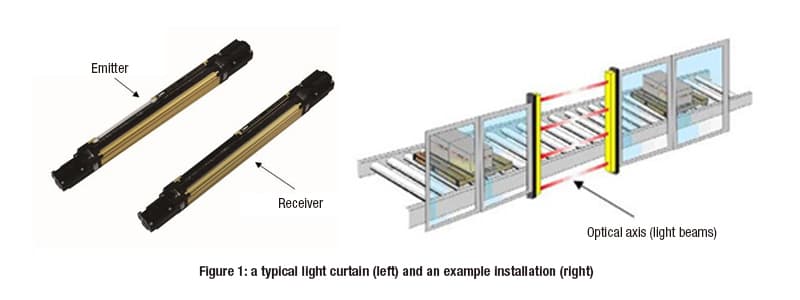
Safety light curtains (also known as ‘light curtains’) are safety devices that use light beams to detect humans and objects moving through doorways that do not have protective doors (as shown in figure 1).
Principles of operation
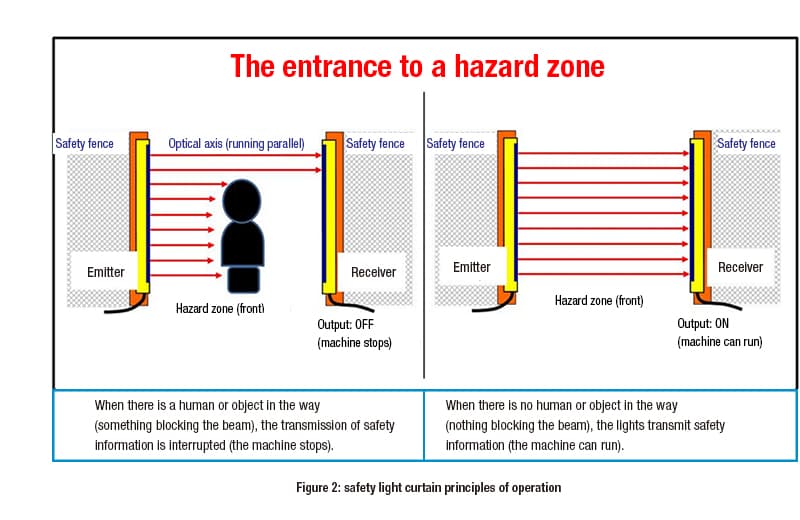
Light curtains use emitters and receivers in combination. These are set up so that the receiver can accurately receive multiple parallel beams from the emitter (as shown in figure 2).
If there is nothing blocking the beam’s travel between the emitter and the receiver (no human or object is passing through), the machine is assumed to be in a safe state because all emitted light beams are reaching the receiver. The receiver’s output is turned on, and the machine can be operated.
However, if any or all of the light beams are blocked (by a human hand, body part, or other object), the system determines the situation to be hazardous. The receiver’s output is turned off, stopping the machine.
The light beams from each axis of the light curtain are projected in a fixed pattern. The receiver’s output is only turned on when the received light matches this pattern.
This mechanism also ensures that the receiver’s output is turned off when the received light pattern is disrupted by strong external light sources, an object blocking the beams, or misalignment of the optical axis.
In other words, the system is designed to ensure safety in several ways. It stops the machine when a human or object passes between the emitter and receiver. It also does so when the emitter and receiver are misaligned, when external light enters the receiver, when light emission stops, or when any other abnormality occurs in the system.
Safety light curtain applications
Here, we will introduce some specific example applications for light curtains.
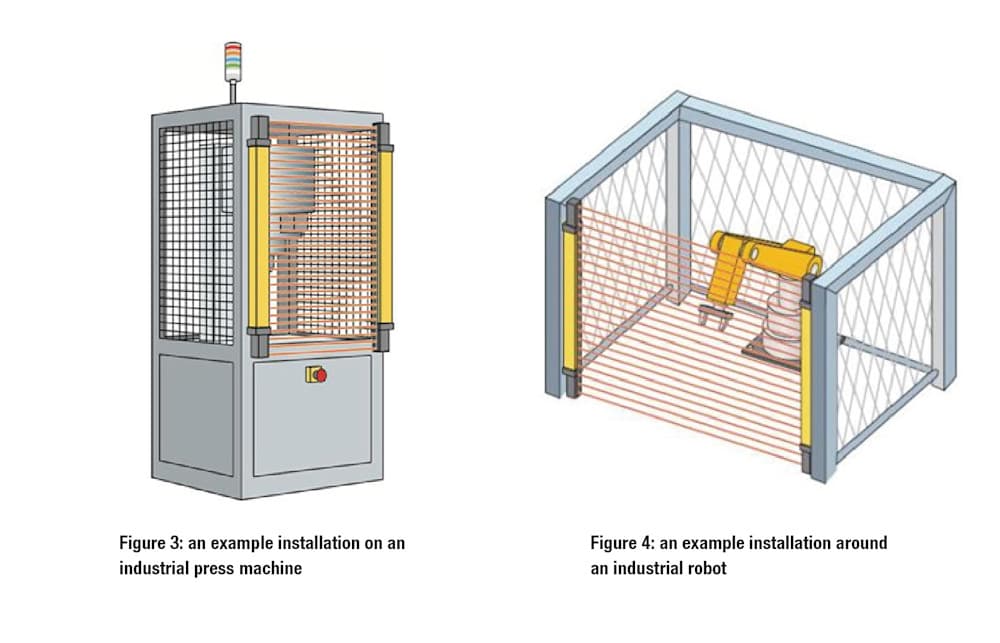
Figure 3 shows an example installation on an industrial press machine. For press machines with a short cycle time, a safety light curtain is used to detect a worker’s fingers, hands, arms, and other body parts while workpieces are being loaded or unloaded.
Figure 4 shows an example installation around an industrial robot. A light curtain can be installed in the opening of a safety fence around an industrial robot, and used as part of the safety fence. When using a light curtain, there is no door to open and close, so workpieces can be efficiently moved through the opening in the safety fence.
Determining where to install a light curtain: ensuring minimum safe distance
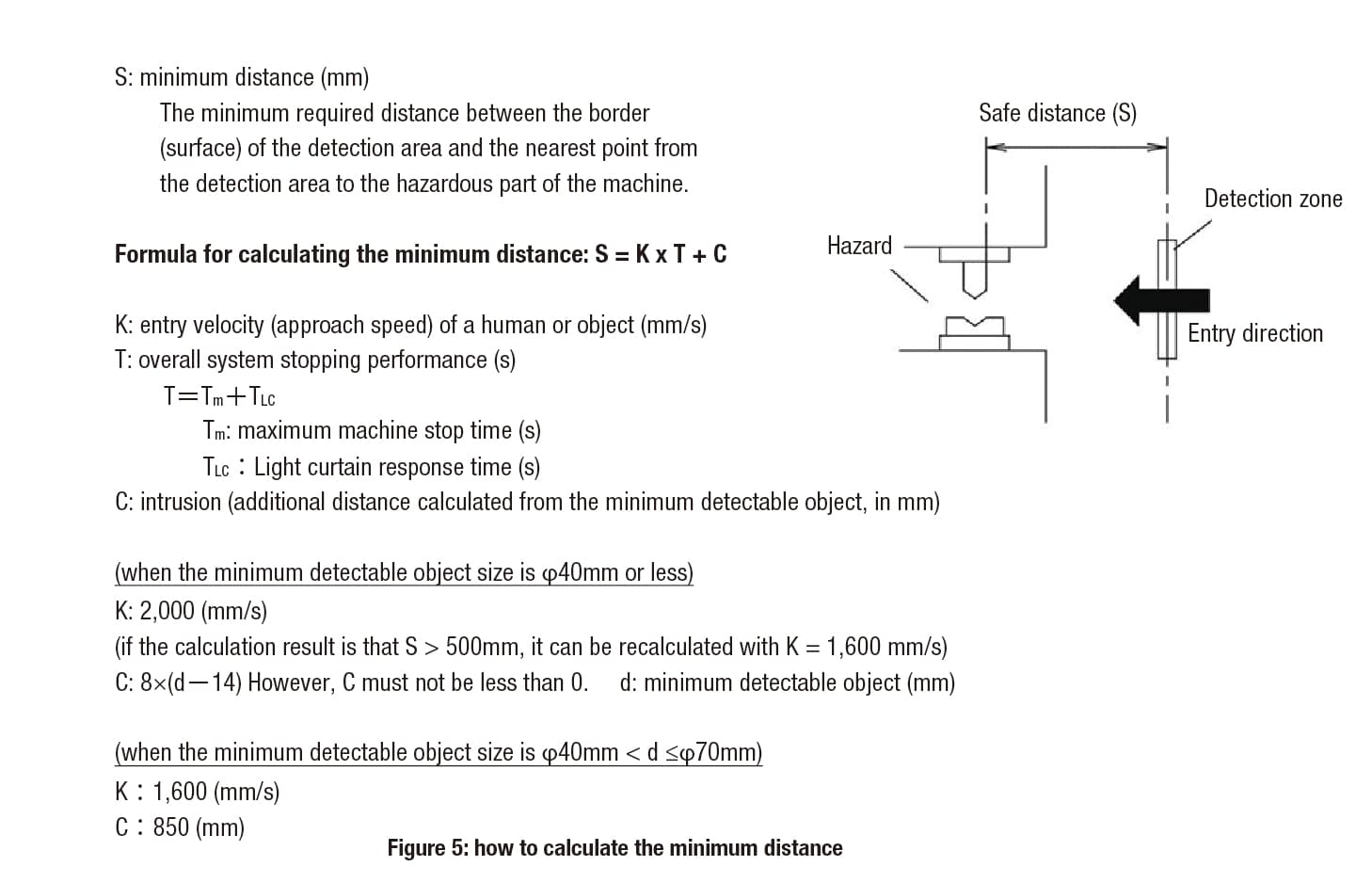
As a light curtain is not a safety fence or a protective door (it does not block entry by humans or objects), it must be installed at a distance (S: minimum distance) from the hazard. This prevents a human or object from coming into contact with the hazard, based on the time (T: overall system stopping performance) taken from detection of something blocking the light beam until the (moving part of the) machine stops.
This minimum distance (S) is used to determine where the light curtain should be installed. To calculate this, a light curtain with an appropriate optical axis pitch (based on the size of the object that will block the light beam) must be used.
The minimum distance (S) for this light curtain is calculated using a pre-determined formula (as shown in figure 5).
As well as the minimum distance (S), the installation height and length of the light curtain must also be checked and confirmed.
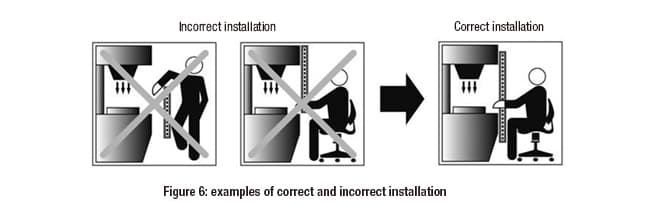
The light curtain must be installed in such a way that no human or object can bypass the detection zone and enter the hazard zone. This includes selecting a length that ensures the light curtain is placed so that humans and objects must always pass through the detection zone to reach the hazard zone (as shown in figure 6).
Safety light curtains are available in a wide variety of sizes, ranging in length from 300mm to 2,000mm. As such, it is important to select a suitable length for the application and installation position.
Precautions for installation and use
As explained above, safety light curtains are devices that ensure safety without using safety fences or protective doors. Take various precautions during installation and use. There are also precautions related to the light curtain’s optical system as an electronic device.
It is not possible to block debris, cutting oil, radiation, or machine noise. If any of these need to be blocked, a light curtain cannot be used. A combination of a protective door and a safety interlock switch (interlocking device) must be used instead.
In steam-filled and dusty work environments, air pollution may block the light rays or make the emitter/receiver lens dirty, leading to detection errors. The lenses may need regular cleaning. Check the installation environment carefully in advance.
External light sources, such as sunlight or strobe lights, can cause detection errors. Install the receiver so that it is not directly exposed to external light.
If there is a reflective surface nearby, such as a wall or other object, light may reach the receiver even if blocked by a human or object. This may lead to detection errors. Check for any potential detection errors before installation.
We provide a wide range of help and resources:
If you have questions or suggestions, we're here to listen.
Our sales and support teams are on hand to help.
All the technical documentation you need.