
IDEC Collaborative Safety / Safety 2.0 | India

Corporate social responsibility and the new approach to safety
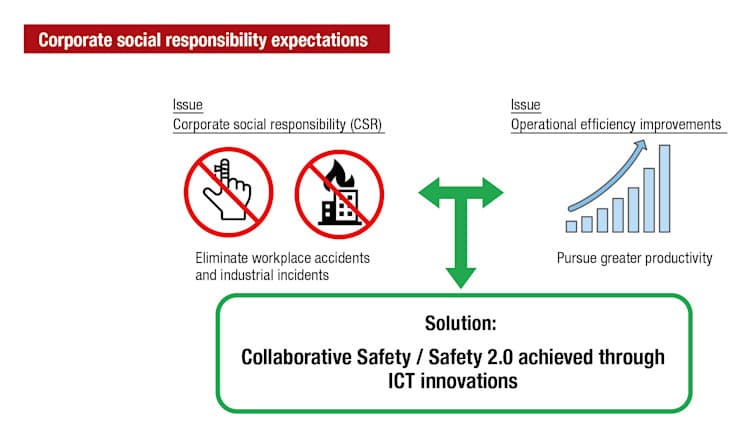
ICT has developed rapidly in recent years, making various aspects of our daily lives much more convenient. ICT systems are also used in industrial applications to improve productivity and efficiency. As a result, there is strong demand for technologies that can ensure safety as other technological advances continue.
IDEC is driving the Collaborative Safety concept, the next generation of safety technology, to eliminate workplace accidents and industrial incidents and improve business efficiency through higher productivity. We are also moving forward with Safety 2.0, the technological measure needed to achieve Collaborative Safety.
What is "safety"?
In international standards, “safety” is defined as “freedom from risk which is not tolerable” (ISO/IEC Guide 51: 2014, 3.14).
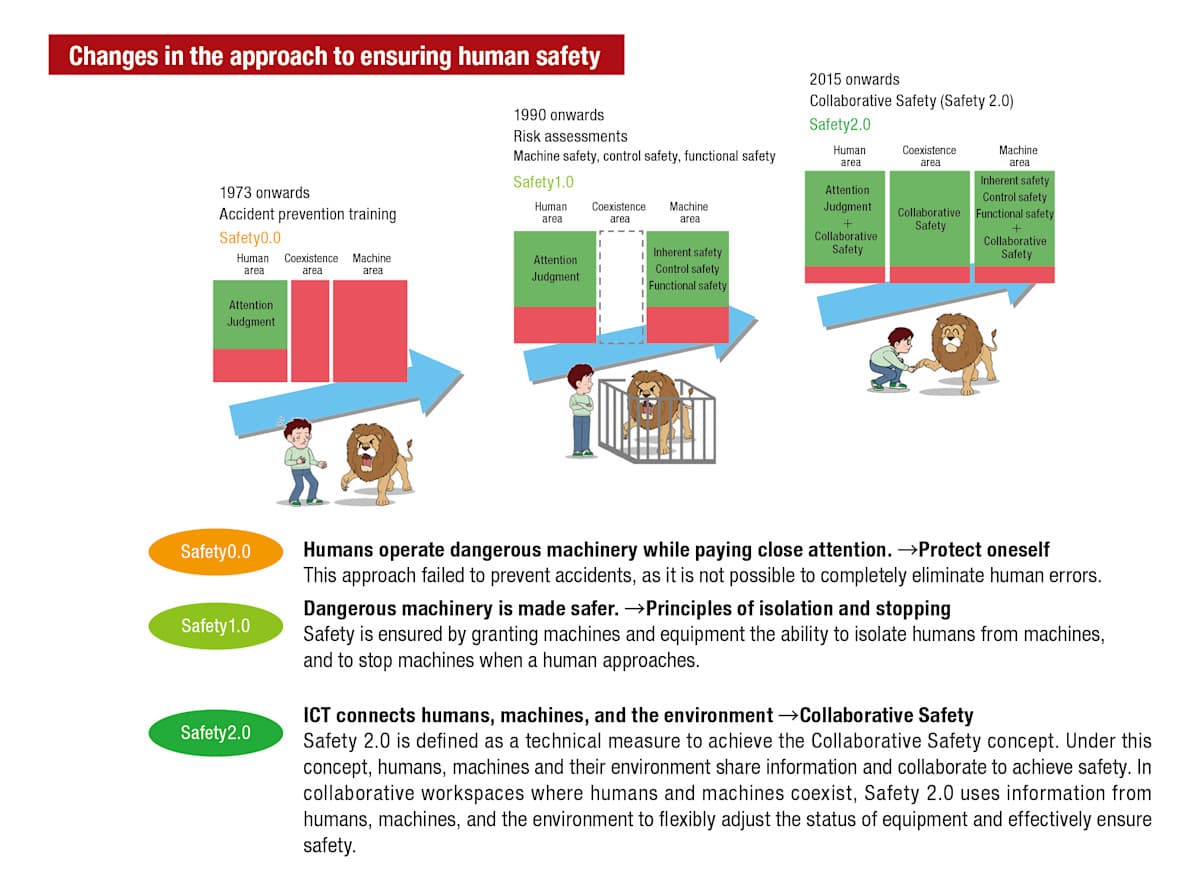
As shown in the diagram below, the method to ensure human safety has evolved from relying on human attention spans (Safety 0.0) to putting distance between humans and machines and/or stopping the machines (Safety 1.0).
With further ‘smart’ innovations in technology and an increase in collaborative workspaces where humans and machines coexist, Collaborative Safety (Safety 2.0) has been advocated as a new concept for a new era of safety.
Collaborative Safety (Safety 2.0)
Collaborative Safety (Safety 2.0) is a concept under which people (humanities), machines (science) and organizations/the environment (social science) share information and collaborate to ensure safety. It originated in Japan as a new form of safety, using advances in ICT to connect things (elements of a system) that were previously handled separately.
Safety 2.0 is defined as a technological measure for Collaborative Safety that makes use of ICT. Using Safety 2.0 technology, humans, machines and their environment can share information and efficiently and effectively collaborate to achieve safety.
4 things that can be achieved with Collaborative Safety (Safety 2.0)
Safety without downtime
By controlling machine speeds and defining operation/protection zones according to each worker’s capabilities, it is possible to ensure both safety and productivity.
For example, identifying a worker’s skill level and health condition enables an optimal level of control (the ability to maintain machine operation and safety) for each worker. In this way, safety and productivity can be improved.
Safety visualization
Using ICT, it becomes possible to visualize the safety status of workers and equipment by monitoring their respective conditions. In the event of any abnormal conditions, appropriate measures can then be taken.
Collaborative fail-safes
The concept of conventional fail-safe design is that if an individual part, machine, or system malfunctions, it does so in the safest way possible. The aim of Collaborative Safety (Safety 2.0) is to realize a new type of fail-safe design, one that uses ICT to unify humans, machines, and their environment.
Equipment size reductions
As humans and machines can safely coexist in their environment, safety fences and other enclosures are no longer needed. This development helps to shrink the footprint of machines and equipment.
Collaborative Safety Levels (CSL)
At Safety 1.0 (machine safety), there are Performance Level (PL) indicators. PL classifies the reliability level of safety-related parts of control systems (responsible for machine safety functions). It is calculated according to the probability of a dangerous failure per hour (PFHD), and based on the inherent risk level of the machinery.
At IDEC, we believe that Collaborative Safety (Safety 2.0) will require new indicators for the optimum levels of safety and productivity: Collaborative Safety Levels (CSL) (as shown in table 1 below).
Once a Collaborative Safety (Safety 2.0) system has been built, these indicators are used to confirm the system’s Collaborative Safety level and identify any missing elements. This information is used to discuss the possibility of future safety level improvements and the direction to take.
| Requirements for Safety 2.0 | Requirements at each Collaborative Safety Level (CSL) | ||||
|---|---|---|---|---|---|
| Category | Details | CSL 1 | CSL 2 | CSL 3 | CSL 4 |
| Ensure measures are in place so that dangerous situations can be avoided in areas where people work | Make use of information about people, and control equipment to avoid dangerous situations | In addition to the CSL 2 criteria, use sophisticated information from machines to urge people to take action and avoid dangerous situations | Implement real-time controls to optimize the safety status of humans and machines | ||
| Criteria | Each element of the system (humans, things, and the environment) is connected by information (ICT) | Information about humans is transmitted to things | By connecting humans and things, information about humans is transmitted to things so that they can control machines | By connecting humans and things, information about things is transmitted to humans so that they can avoid certain actions | By connecting humans and things (and their environment), the optimal condition of all elements can be controlled |
| Risk-related information (danger/hazard and safety information) is monitored and shared | Information about dangers/hazards is monitored and shared | By sharing information about the behavior and status of humans, the risk to each human is confirmed (reduced) | By sharing accumulated information and the operational status of things, the risk to machines is confirmed (reduced) | Risk is shared and confirmed (reduced) between a variety of elements, including humans, things, and their environment | |
| Risk-related information is received, safety is guided by either autonomous or heteronomous control | Through human action/machine operation (heteronomous control), dangerous situations are avoided | Through human action/machine operation (heteronomous control) or status confirmation (autonomous control), things are controlled to avoid dangerous situations | Accumulated information and the operational status of things is shared and analyzed, human action/machine operation (heteronomous) or machine control (autonomous) is used to avoid dangerous situations (risk to humans) | Information is used to analyze and learn from various elements (humans, things, and their environment), to implement optimized risk reduction measures, and to autonomously avoid dangerous situations | |
| Contributions to productivity |
For new equipment: achieve the production capability goal, or improve it For existing equipment: maintain production capability, or improve it |
||||
| Communication and control technologies | Signals | Data transmission | Interactive communication (two-way) | Use of AI | |
4 elements needed to achieve Collaborative Safety (Safety 2.0)
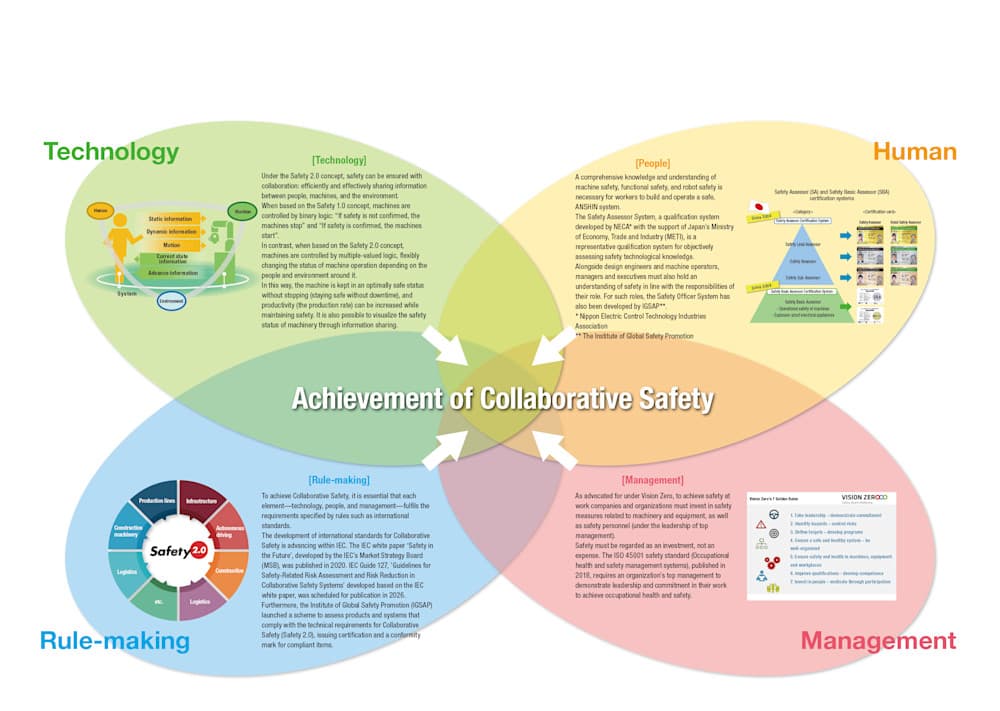
Collaborative Safety (Safety 2.0) involves more than just technology. The 4 aspects of Collaborative Safety (technology, people, management, and rule-making) share information and work together to achieve high levels of both safety and productivity.
When top management in an organization positions safety as a vital aspect of their corporate strategy, new levels of safety and productivity can be reached in environments where humans and dangers/hazards (machines and equipment) coexist.
We provide a wide range of help and resources:
If you have questions or suggestions, we're here to listen.
Our sales and support teams are on hand to help.
All the technical documentation you need.