
What is a safety device? | India
Safety devices are designed to safely control machinery and equipment, based on the principle of machine safety. They ensure safe operation and maintenance of machinery and other equipment at factories, chemical plants, and other industrial work sites. Some safety devices are built into machinery and equipment by the manufacturer, and others are installed on site as needed by system integrators or end users.
Safety devices are effective for reducing risks during machine operation.
If a safety device fails, or the controls are operated in a different way than intended, that can result in an immediate increase in risk – and the possibility of harm to humans also increases. For this reason, safety devices must have specific safety functions (machine functions where failure can result in an immediate increase in risk).
Safety devices used for industrial machinery and equipment typically have the following safety functions:
Limiting the operating area of machinery | Mechanical stopper devices, wedges |
Limiting steam and/or air pressure | Release vents (safety valves) |
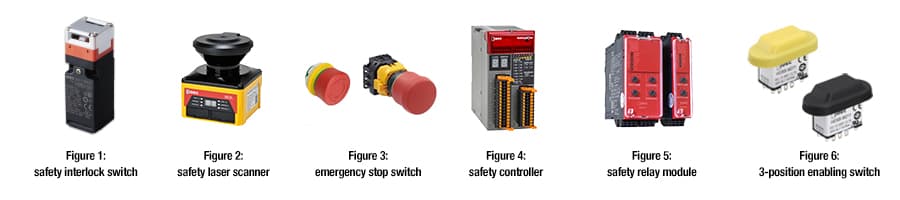
Detecting opening/closing of protective doors, fences, guards, covers, etc. | Safety interlock switches (figure 1), safety limit switches |
Preventing humans from touching moving parts of machinery | Covers, lids |
Detecting when a human is approaching machinery, or human presence within the operating area of machinery | Safety light curtains, safety laser scanners (figure 2), safety mats |
Rapid detection of human-machine contact | Bumper switches |
Immediate activation when a human senses danger | Emergency stop switches (figure 3) |
Allowing machine output once the safe state is confirmed | Safety controllers (figure 4), safety relay modules (figure 5) |
Ensuring safety while teaching robots, etc. | 3-position enabling switches (figure 6) |
The safety-related parts and non-safety-related parts of control systems
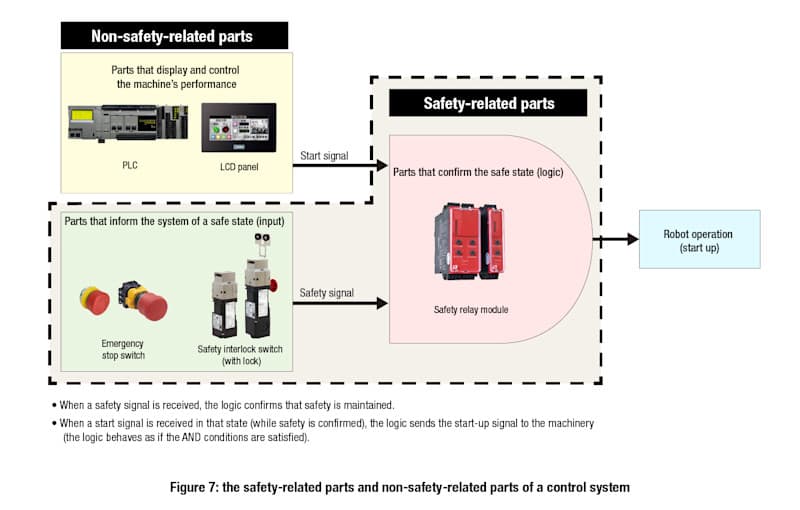
In the field of machine safety, where safety devices are used, we distinguish between safety components in a control system by referring to parts of a control system that carry out safety functions as the “safety-related parts”, and the others as “non-safety-related parts”.
Safety devices are used in the “safety-related parts” of a control system. An electrical signal indicating a safe state is only sent from the input device to the logic unit once safety has been confirmed.
The machine can only start up in response to a command from a non-safety-related part while the signal monitoring the safe state is recognized by the logic unit. However, if the safety status cannot be confirmed or the safety-related part itself has failed, the machine shall not start.
The interlock is one of the typical functions that makes use of this concept. The interlock is a function that maintains the stopped state of hazardous machinery when a door (cover) isolating a dangerous part of the machine is not closed, or when a human is working in a hazardous area.
The non-safety-related parts of the control system can be regarded as the parts that allow machinery and equipment to fully demonstrate their performance. Specifically, these parts control the functions that can be considered “selling points” of the machine, such as motor speed control and precise positioning control for the movement area.
A typical example of the relationship between the “safety-related parts” and “non-safety-related parts” of a control system is shown in figure 7.
We provide a wide range of help and resources:
If you have questions or suggestions, we're here to listen.
Our sales and support teams are on hand to help.
All the technical documentation you need.