
Nature-related Initiatives
Biodiversity
Basic Concept
We consider that biodiversity creates diverse values and services such as water, plants, and oxygen on the earth, and it is one of the most important foundations supporting the IDEC Group's business continuity. We also think that biodiversity is an important issue to be addressed as well as climate change.
While the IDEC Group has been implementing Task Force on Climate-related Financial Disclosures (TCFD) disclosures since 2022 as part of its environmental information disclosures, stakeholder requests are now expanding beyond climate change to include biodiversity and other areas covered by Task Force on Nature-related Financial Disclosures (TNFD) disclosures.
The IDEC Group discloses nature-related financial information using the LEAP approach, including analyses of dependencies and impacts, risks and opportunities, as well as metrics and targets.
Analysis of Biodiversity Risks
Since FY2024, we have conducted the analysis and assessment of the IDEC Group's biodiversity risks in order to define indicators that help assess impacts on biodiversity by the IDEC Group's business activities and monitor biodiversity results. Using the Biodiversity Risk Filter developed by the World Wide Fund for Nature (WWF), we quantified biodiversity risks by country for FY2026.
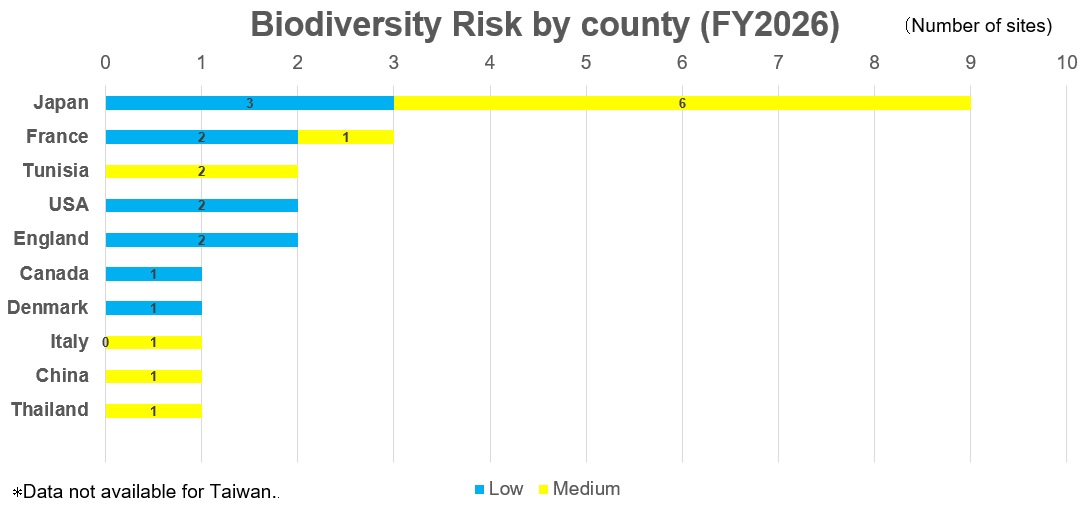
The following graph shows the latest quantified results of the IDEC Group's biodiversity risks based on the risk assessments of each site by country. Overall assessment of 24 sites in the world were rated as low or medium risks, and there was no site with high biodiversity risk.
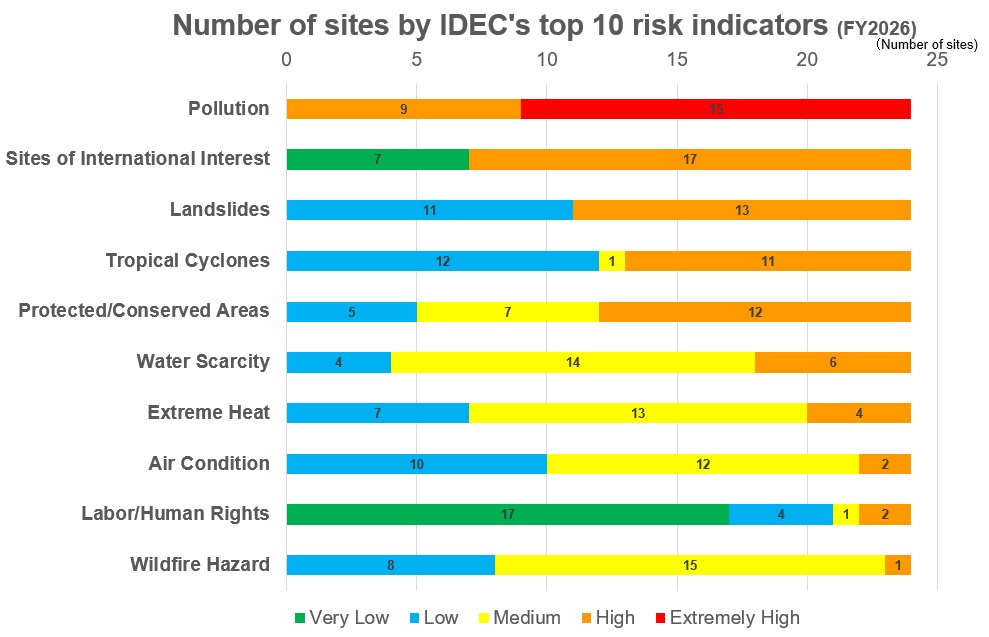
The following graph shows the quantified results of the IDEC group's top 10 biodiversity risks based on the assessment of each site. The biodiversity risk indexes with the high risk are landslides, tropical cyclone and water scarcity. The percentage of locations with high risk overall was about the same as last year, and there was no deterioration in the risk score.
Regarding wildfire hazard, the number of sites assessed as having a medium level of risk increased significantly from 6 to 15 in FY2025. In FY2026, however, the number remained unchanged at 15 sites, indicating no further deterioration in the overall risk profile.
Since the beginning of 2025, large-scale wildfires have occurred in Los Angeles in the United States, Australia, South Korea, Chile, and other regions. In Japan, wildfires have also occurred in Iwate, Okayama, and Ehime prefectures, resulting in forest loss. The causes of wildfires include not only human activities but also climate-related factors such as rising temperatures, declining precipitation, prolonged drought conditions, and strong winds.
Going forward, we plan to track changes in the risk score for each climate-related biodiversity risk index and grasp and analyze the current situation for each site assessed as being at high risk. In addition to TCFD disclosures, we plan to disclose nature-related financial information based on the TNFD framework and utilize the Leveraging Environmental and Natural Capital for Performance (LEAP) approach to assess risks and opportunities through the Environmental Strategy Committee.
Greening of IDEC Group's Business Sites
We have addressed to preserve biodiversity through greening of our business base sites.
IDEC's Head Office
<Courtyard of head office>
In June 2018, the courtyard was renovated and more than 30 kinds of trees including local varieties of Japan were planted for the recreation of a forest dominated by native species of the region. We named it "Izumi Forest." In March 2023, the IDEC head office’s green space was certified as a private business green space with excellent conservation and creation activities under the Social and Environmental Green Evaluation System Operation, Management and Active use program (SEGES OMA) of the Organization for Landscape and Urban Green Infrastructure. In 2026, we have achieved an upgrade to the "Excellent Stage 3" certification label under the OMA—Operation, Management and Active Use of Green Spaces. (Click here for details).
In the Izumi Forest, employees have handcrafted food boxes using recycled materials and placed them with husk food such as barnyard millet and foxtail millet, as well as sunflower seeds harvested at the Fukusaki Plant. Birdbaths are also set up as watering holes for wild birds to take a break, and eco-stacks are set up as habitats for small creatures such as insects and reptiles.


Amagasaki Plant
As part of our activities to help employees experience the seasons, we grow sunflowers every year. The harvested seeds are not only distributed to employees, but are also used as food for wild birds in the Izumi Forest of the company's headquarters.

Fukusaki Plant
We grow seasonal flowers such as salvia, the flower of Fukusaki Town, and sunflowers. In the future, we are considering using it as a place to protect and cultivate native species.
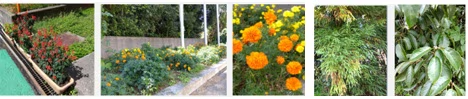
Survey of wildlife at business premises
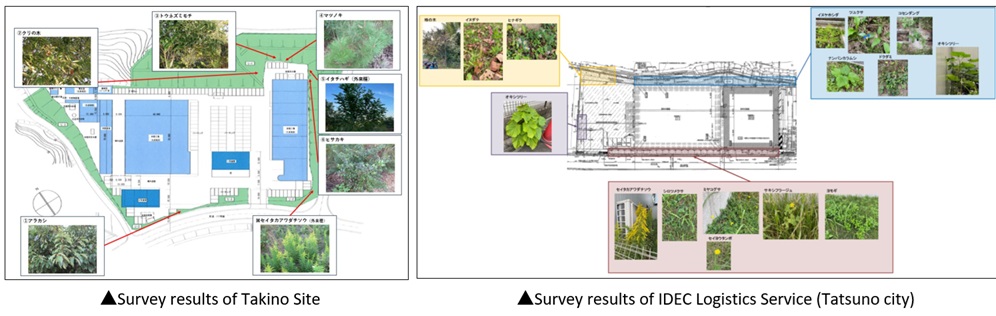
Hoping to contribute to environmental conservation by understanding the impact on the local ecosystem around business sites, members of the business sites took the lead in conducting a wildlife survey around the head office, Takino, Fukusaki, Amagasaki, and IDEC Logistics Service (Tatsuno City). We also received advice from an external inspection organization for SEGES' "Fostering Green" certification, which was acquired by our headquarters in FY2024, and eradicated invasive species (such as Solidago altissima) to prevent damage to the ecosystem.
Environmental Training
Environmental E-Learning
Regarding the environmental training, we publish articles in the "Environment Words" series on our intranet in FY 2026 as well.
The environmental e-learning program, which has been implemented since 2022, has been expanded to include Simplified Chinese and Traditional Chinese versions. This expansion was made in response to requests from local sites in Suzhou and Taiwan, in addition to the existing Japanese and English versions. Through these efforts, many employees are enhancing their awareness of environmental issues and actively engaging in self-development.
(Training materials translated by members of the Global Environmental Management Steering Committee from IDEC IZUMI SUZHOU (left) and IDEC IZUMI TAIWAN (right).)

Biodiversity through "food"
In order to have employees feel familiarity with biodiversity through food, dishes with sustainable materials were provided at the cafeteria of head office during the sustainable month in October.
Cafeteria of the IDEC Head Office (Japan)
Salmon cream pasta used with farmed salmon and salmon roe acquired the international certified standard “ASC certification” (left photo) and lemon creme pasta with shrimp (right photo) were provided weekly. At the cafeteria of head office, the Rainforest Alliance Certified coffee is provided all through the year.

IDEC IZUMI(Hong Kong)
A “vegetable day” on which we have one meal or all meals with only vegetables was conducted at the office and the restaurant for vegetarians. Meals with only vegetables not only promote health but contribute to protect environment by forest protection and reduction of GHG and wastes in the situation of losing biodiversity caused by cattle raising

Water Resources
Basic Concept
Water resources are essential not only for human and plants, but all living organisms on the earth to live. On the other hand, approximate 2 billion people on the earth are forced to be in the condition of difficulty in using water controlled safely. It is said that 1.8 million children die annually caused by unsanitary water (Source: United Nations Information Center).
Although the IDEC Group does not have any manufacturing processes or services that are heavily dependent on water resources, and most of the water resources we use are limited to water supply, we regard that water problems such as water shortage and water pollution impact on not only IDEC Group's business, but also the livings of our employees and their families.
Based on the "SAVING spirit" we have cherished since the foundation, we will use water resources with gratitude and address to reduce loads caused by our business activities on nature.

Analysis of Water Stress
Water resource is important for business continuity of the IDEC Group as well as for all the livings in the global environment. On the other hand, due to the impact of climate change such as global warming, water risks including water shortage, concentrated heavy rains, and floods are increasing every year.
For the purpose of controlling water resources properly and utilizing assessment results of water risks to business continuity, we have assessed water risks of 24 sites including manufacturing, development of all IDEC group in addition to head quarter every year since FY2024. As an assessment tool, we adopted Aqueduct Water Risk Atlas 4.0 developed by World Resources Institute to quantity risks of water stress, river line flood, coastal flood, and drought of each site. In addition, we investigate the amount of water intake per site.
The following is the world map that shows Aqueduct overall water risk per each IDEC site. Among 24 sites, five sites (one site in Thailand and each two sites in USA and Tunisia) were assessed as extremely high-water risk. There was no significant change compared to last year's results.

The assessment results of water stress indicate that five sites (one site in Thailand and each two sites in USA and Tunisia) were rated as extremely high risks. The amount of water intake by five sites assessed as extremely high and high risks accounts for 22.37% of the total of IDEC group's water intake in FY2026.
As for other risks, there are physical risks, groundwater table declines, seasonal variability, drought, river line floods, and coastal floods, etc. We schedule to conduct risk assessments using Aqueduct once a year, and results will be updated.

Utilization of Rainwater Storage (Head office, Tunisia)
Two rainwater storage tanks were installed underground when the head office was constructed in 2013. Maximum 148㎥ rainwater can be stored underground, and standing water has been used effectively for watering on the courtyard and sprinkling when the temperature rises. Furthermore, the installation of a rainwater harvesting system at SACEMA (Tunisia), our manufacturing facility in Tunisia, led to a 9.2% decrease in water consumption in FY2026 compared with the previous year.

Water conservation awareness campaign (IDEC IZUMI SUZHOU CO., LTD.)
During the Sustainability Month in October 2023, IDEC IZUMI SUZHOU CO., LTD. (China) conducted a water-saving campaign in which all employees participated. By raising employees' environmental awareness through weekly news about the water situation on topics such as "The global water situation" and "Why water shortages occur" and by introducing specific water-saving methods, we were able to achieve a water saving of approximately 3%. We will continue to work towards saving water.

Public Water Supply (Japan's Data only)
Information disclosure based on TNFD
The IDEC Group's environmental-related disclosures have been aligned with IFRS S2 since 2024, but stakeholder demands are expanding from climate change to include biodiversity and TNFD.
Therefore, starting in fiscal 2025, we have begun preparations to disclose information aligned with the TNFD framework and to identify nature-related issues using the LEAP approach for risk and opportunity assessment. Utilizing LEAP, we disclose information aligned with the four elements of the TNFD framework: governance, strategy, risk and impact management, and metrics and targets.
Governance
The board of directors oversees important sustainability matters such as TCFD and TNFD. The Environment Strategy Committee which is one of the specialized Sustainability Committee, takes the lead in conducting analysis and evaluation regarding nature-related risks and opportunities, dependencies, and impacts.
Strategy
To clarify the relationship between our business activities and their dependencies and impacts on nature, we conducted a materiality assessment using the external tool ENCORE. While the dependency and impact items identified by ENCORE represent industry-wide, general items, some of them did not fully reflect the specific characteristics of our business activities. Accordingly, from the results of the materiality assessment, we identified water supply as a key dependency, and CO₂ emissions as well as the discharge of hazardous pollutants into water and soil as key impacts that are highly relevant to the IDEC Group’s business activities. Based on ENCORE’s analysis and the discussions conducted during the workshops, we identified four types of natural capital on which the IDEC Group’s business activities depend: water, soil, biodiversity, and minerals.
Dependency and impact on natural capital
| Natural capital | Dependency | Impact | Factors that have impact | |||||
| Atmosphere | Low | Low | Weather conditions, drought, changes in ocean currents, and circulation | |||||
| Land geomorphology | Medium | Medium | Floods, earthquakes, landslides | |||||
| Minerals | Medium | Medium | Changes in Land/Freshwater/Seabed | |||||
| Ocean geomorphology | Changes in Land/Freshwater/Seabed | |||||||
| Soils and sediments | Low | Low | Changes in Land/Freshwater/Seabed, changes in pollutant concentration, changes in species composition | |||||
| Species | Changes in diseases, species composition, and weather conditions | |||||||
| Structural and biotic integrity | Medium | Medium | Floods, changes in land/freshwater/seabed, fires | |||||
| Water | Medium | Medium | Drought, changes in pollutant concentrations, sea level rise | |||||
Risk and impact management
In considering nature-related risks and opportunities, we conducted risk and opportunity workshops in Japan, China, Taiwan, and Thailand in FY2027. During these workshops, we discussed the IDEC Group’s dependencies on and impacts on natural capital, as well as related risks and opportunities associated with our business activities. Based on these discussions, we compiled the IDEC Group's major nature-related risks and opportunities, as well as its dependencies by type of natural capital.
Major nature-related risks
| Classification | Items | Responses | |
|---|---|---|---|
| Physical risks | Acute | Operational shutdowns at key suppliers; disruptions to logistics and supply chains (floods, typhoons) | BCP development, securing alternative sourcing, inventory strategy, and utilization of cloud technologies |
| Heat stress among workers due to rapid increases in temperature and humidity | Heat stress prevention measures (salt tablets, hydration, cooling garments) | ||
| Chronic | Declines in productivity and quality due to deteriorating working conditions caused by rising temperatures | Improvement of air conditioning and ventilation systems in factories and workplaces | |
| Reduced production volumes due to power usage restrictions resulting from fossil fuel depletion | Transition to component/material specifications designed for high-temperature environments | ||
| Transition risks | Policy | Assessment and use of recyclable materials, implementation of usage restrictions, and review of procurement practices | Diversification of suppliers, use of recycled materials, and monitoring of policy developments |
| Assessment and use of recyclable materials, implementation of usage restrictions, and review of procurement practices | Switch to low-carbon electricity and environmental management systems (ISO 14001) | ||
| Market | Investment avoidance due to deterioration in ESG ratings, increased environmental requirements from customers, and suspension of business transactions | Promotion of ESG Management and Enhancement of Environmental Information Disclosure | |
| Demand fluctuations and shifts in customer requirements; surge in global mineral prices (copper and rare metals) | Ongoing monitoring of mineral and metal markets and revision of pricing contracts | ||
| Technology | Technological obsolescence due to environmental requirements: delays in the transition to energy-efficient equipment and low environmental impact materials |
Development of a technology strategy
Strengthening of R&D investment
Promotion of the development of eco-friendly technologies
Technical collaboration with external partners
|
|
| Obsolescence of existing products due to the emergence of resource- and energy-efficient competing technologies | |||
| Reputation | Reputational damage and social media backlash from inadequate waste and chemical management |
Strengthened supply chain management and development of a
supplier code of conduct
Conduct of environmental and human rights due diligence
|
|
| Liability | Litigation and liability risks associated with environmental pollution, ecosystem damage, and water and soil contamination |
Environmental regulatory compliance and operation of an
environmental management system (ISO 14001)
Enhanced waste management, strict wastewater control, and
regular internal audits
Establishment of an emergency response system
|
|
Major Nature-Related Opportunities
| Classification | Items | Responses | |
|---|---|---|---|
| Corporate performance | Market | Rising demand for eco-friendly products (eco-friendly materials, products with low water and CO₂ use, low energy consumption, and high resource efficiency) | Environmental certification, manufacturing technology development, investment, energy-saving proposals for customers, and enhanced R&D of eco-friendly products |
| Revenue opportunities from early development aligned with market trends | Solution-based sales aligned with customers’ ESG and environmental initiatives | ||
| Resource efficiency | Cost savings from improved water and energy efficiency in operations | Introduction of renewable energy | |
| Reduced use of copper, aluminum, and rare metals in development, and use of recycled materials | Consideration of alternative materials and establishment of recycling loops | ||
| Products and services | Proposal-based business for optimizing energy efficiency across entire production lines | Packaging of “energy savings visualization” and “optimal robot control” | |
| Increasing interest in eco-friendly products | Bio-based materials R&D and enhanced sensor technologies | ||
| Capital flows and financing | Growing subsidies and incentives for investment in high environmental performance equipment | Utilization of subsidies for the introduction of energy-efficient equipment (METI and MLIT) | |
| Reputational capital | Enhanced brand value as an environmentally responsible company | CSR activities and supplier engagement | |
| Sustainability Performance | Sustainable use of natural resources | Sustainable procurement through the use of recycled materials (copper and plastics) | Use and evaluation of recycled materials |
| Expansion in the use of certified and recycled materials | Continuation of ongoing initiatives: establishment of green procurement standards, preferential use of certified materials, installation of solar panels, and purchase of renewable electricity | ||
| Ecosystem protection, restoration, and regeneration | Increased customer selection as a company promoting ecosystem-conscious practices | Formulation of procurement policies that consider ecosystems (e.g., zero deforestation) | |
| Contribution to local communities through greening and ecosystem restoration within and around sites, as well as measures against invasive species | Biodiversity surveys, environmental restoration projects, collaboration with local governments and communities, installation of biotopes and eco-stacks, removal of invasive plant species, and vertical greening | ||
Major dependencies and impact by natural capital
| Natural capital | Major Dependencies | Major Impact | |||||||||||||
| Water resources | Manufacturing water use (molding, cooling, cleaning, chemical processes, etc.) | Impact on depletion due to water resource use | |||||||||||||
| Water resource depletion due to overuse | Impact on rivers, ponds, and other water bodies due to wastewater discharge from septic tanks | ||||||||||||||
| Water use for domestic purposes | |||||||||||||||
| Soil | Land use for factories and offices | Impact on ecosystems due to soil degradation and land-use change | |||||||||||||
| Soil associated with on-site and facility landscaping | |||||||||||||||
| Biodiversity | Wood materials (cardboard, crates, pallets) | Impact on biodiversity through deforestation, excessive water use, water pollution from effluent, and species decline due to habitat destruction associated with pulp production in the supply chain | |||||||||||||
| Impacts on biodiversity from the use and disposal of timber materials and hazardous substances | |||||||||||||||
| Impacts of pulp production on forests and water | Impact on biodiversity due to the unintended use or disposal of hazardous substances | ||||||||||||||
| CO₂ emissions from manufacturing energy use | |||||||||||||||
| Metal and mineral resources | Supply chain dependence on metals and mineral resources | Impact on depletion of metals due to component use | |||||||||||||
| Dependence on petroleum‑based resins and insulation materials | Pressure on natural resources due to material use | ||||||||||||||
| Use of metals in component manufacturing and depletion risk | Residual accumulation of non-biodegradable metal waste disposed of as industrial waste | ||||||||||||||
| Upstream environmental impacts associated with component procurement (including soil erosion, water pollution, and ecosystem degradation) | |||||||||||||||
| Atmosphere | Use of sunlight for solar power generation | Greenhouse gas emissions resulting from the use of electricity and fuels | |||||||||||||
| GHG emissions from electricity and fuel use | Greenhouse gas emissions from commuting by private vehicles | ||||||||||||||
| Land geology | Petroleum consumption from plastic packaging use | ー | |||||||||||||
| Fossil fuel extraction for power generation | ー | ||||||||||||||
| Marine geology | Supply chain marine transport and port use | ー | |||||||||||||
| Port use and seabed resource extraction | ー | ||||||||||||||
Metrics and Targets
As measurable indicators in IDEC's business activities, we selected four items from the measurement indicators defined by the TNFD.
TNFD's measurement indicators on dependencies and impacts
| Measurement Indicator No. | Drivers of Natural Change | Indicator | Measurement Indicator | Relevant Elements in IDEC | |||||||
| ー | Climate change | GHG emissions | Refer to ISSB's IFRS S2 "Climate-related Disclosures" | CO2 Emissions | |||||||
| C3.0 | Resource use/ replenishment | Intake and consumption from water-scarce regions | Water withdrawal and consumption70 (m3) from areas of water scarcity, including identification of water source. | Water consumption by site and total | |||||||
| Measurement Indicator No. | Drivers of Natural Change | Measurement Indicator | Relevant Elements in IDEC | ||||||||
| C7.2 | Risks | Description and value of significant fines/penalties received/litigation action in the year due to negative nature-related impacts. | Non-financial indicators listed on IDEC Integrated Report | ||||||||
| C7.4 | Opportunities | Increase and proportion of revenue from products and services producing demonstrable positive impacts on nature with a description of impacts. | Sales of enhanced eco-friendly products | ||||||||