
Risk Management
Risk Management System
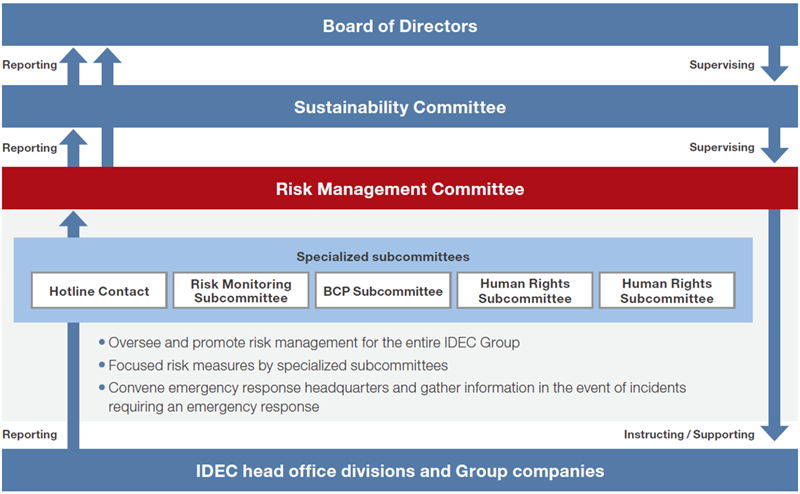
IDEC has established the Risk Management Committee as a specialized committee under the Sustainability Committee, chaired by the CEO, with the objective of avoiding, mitigating, and transferring risks to the IDEC Group in advance, and minimizing damage in the event of an emergency response event.
The Risk Management Committee is responsible for overseeing the Group’s overall risk management during normal times and responding in the event of an emergency. In addition, the committee has established specialized subcommittees to address
risks that require particular focused efforts.
The Risk Management Committee’s initiatives are reported to the Sustainability Committee, which meets twice a year, and the committee then reports to the Board of Directors. In addition, the Risk Management Committee is able to report directly to the Board of Directors on important events such as internal (whistleblowing) reports, ensuring that risk information is reported appropriately to management.
Risk management process
Events that could negatively impact the IDEC Group’s continued business expansion and corporate value enhancement are identified as ‟risk events.ˮ The Risk Monitoring Subcommittee conducts risk assessment and monitoring of countermeasures for these risk events. Every year, for each risk event, a questionnaire survey is conducted using the ‟probability of occurrence,ˮ ‟magnitude of damage,ˮ and ‟impactˮ as indicators, across Group companies and business functions, and the results are used to assess risks on a relative basis. Among them, risk events that are evaluated as having a high probability of occurrence or high impact are selected as ‟high risk events,ˮ and the affected departments or group companies plan and implement countermeasures to reduce risk.


Results of risk assessment
Based on the results of the risk assessment conducted across the IDEC Group, the following risks have been identified as high-risk events.

Events | Description of potential risks |
➊ Natural disasters | Risks of operational suspension and damage resulting from natural disasters such as earthquakes, torrential rain, flooding, typhoons, and forest fires. |
➋ Geopolitical risks | Risks that safety and business continuity may be disrupted due to geopolitical factors such as conflicts, terrorism, and deterioration of public security. |
➑ Product accidents | Risks of serious product accidents that may have an impact on human life or physical safety. |
➒ Quality misconduct | Risks of quality misconduct arising from falsification of product performance or data. |
⓫ Strategic investments | Strategic investment risks, including the impact on financial conditions resulting from strategic investments such as M&A and business alliances. |
⓮ Mass employee turnover | Risks of labour shortages due to the mass resignation of employees. |
⓱ Cybersecurity risks | Risks of prolonged network outages caused by cyber attacks. |
Business Continuity Planning (BCP)
Within the IDEC Group, the BCP Subcommittee of the Risk Management Committee promotes the formulation and enhancement of Business Continuity Plans (BCPs) in Japan and overseas in accordance with our basic policy on business continuity. These BCPs are based on an all-hazards approach, which assumes not only natural disasters such as large-scale earthquakes but also all other events that may affect business continuity.
In addition, we conduct annual training programs for employees, and ensures the effectiveness of our BCPs by reviewing and improving them based on the results of these exercises. In March 2026, a simulation-based tabletop exercise assuming a large scale earthquake was conducted for members of the BCP Subcommittee. The results of this exercise will be utilized to review the BCPs and will also be reflected in employee training programs from FY2027 onward, with the aim of implementing more effective training initiatives.
IDEC Group basic policy for crisis response
•To place the highest priority on the safety of employees and their families
•To maintain quality and establish systems and frameworks that ensure the uninterrupted supply of products, enabling us to meet customer requirements by providing safe and ANSHIN products and services even in times of crisis
•To recognize the importance of daily preparedness and training, and to establish strategies and frameworks that incorporate effective crisis response